
The Way of a Warrior: How Cesca Litton-Kalaw Is Fighting For Her Life
October may have come and gone, but spreading awareness on the early detection of breast cancer is a year-round task. TV host and breast cancer survivor Cesca Litton-Kalaw opens up about her ordeal battling the Big C, and shares with us just how crucial early detection is.



“The times that I cried, I think I cried out to my mom.”
It’s a very raw, very telling, very honest statement from sports anchor, host, and breast cancer survivor Cesca Litton-Kalaw, who is in the middle of telling us that during six cycles of chemotherapy, she barely cried or showed any emotion. Instead, she forced herself to power through, focusing on getting through the physically taxing cycles and doing “what needed to be done.”
The opening salvo
In December of 2024, Litton-Kalaw was diagnosed with breast cancer, and today, she is detailing her recent ordeal for Allure Philippines. To battle cancer is a fight that requires, among many other things, a will of steel—something Litton-Kalaw evidently knew as she strapped on her armor and went to war for her life.
“I can probably count on one hand the times that I actually cried. I couldn’t let myself feel, otherwise I don’t think I would have gotten through the treatment,” she admits. “It was either I would talk to my mom or talk to God.”
Her mom is Grace, who passed away when Litton-Kalaw was ten years old—from cervical cancer. The history of cancer in her family had a doctor friend of hers recommending that Litton-Kalaw go straight to an oncologist when she found a lump in her right breast, discovered while changing her clothes. Earlier in the year, she had already noticed something that felt like hard muscle in the same spot, but, since she had been regularly hitting the gym, she brushed it off as gains from working out.
“The oncologist checked it and said that I needed to see a surgeon, because the lump was already pretty sizable,” Litton-Kalaw narrates. She had a mammogram and a breast ultrasound—her first time for both—and immediately after, the doctors in the ultrasound room confirmed that she needed to see a surgeon right away, explaining that “it wasn’t looking good.”
The plan of attack
A biopsy later, it was confirmed: stage two breast cancer. Litton-Kalaw’s solution was to barrel forward, opting to have a unilateral mastectomy, or surgery to remove one breast, in hopes to avoid chemotherapy, the effects of which concerned her and her husband, Tyke. “There’s a history of cancer in my family. [Better to] just take it all out,” she shares. She and her surgeon also opted to remove two lymph nodes closest to the cancerous mass as a precaution, and Litton-Kalaw made the decision to have breast reconstruction done on the same day as well.
However, there was no escaping chemo, which her doctors advised her was a safeguard to make sure all traces of cancer were eradicated. Six weeks after her surgery, Litton-Kalaw started the six cycles of chemotherapy, losing her hair and sense of taste, suffering from the multitude of side effects which were, on the whole, terribly unpleasant. As she looks back, it seems it was at this point that she began unpacking the reality that, yes, she indeed had cancer, describing going through each step as an out-of-body experience that culminated in a cascade of emotions as her chemo sessions came to an end.
“The closer I got to the final chemotherapy cycle, the more I felt myself unraveling. On the day of my sixth and final chemotherapy cycle, I kind of felt myself falling apart,” she recalls. “When the nurse was removing the IV from my hand, tears were already rolling down my cheeks. I remember waking up the next day, sobbing out of nowhere, and that continued for maybe five days straight. I think that was the only time I allowed myself to just let everything out.”
As a person, Litton-Kalaw is gregarious—sharp and witty, with a presence that you can’t ignore. But the weight of cancer is so crushing that it tramples on even the strongest of personalities. Yet it is a weight that can be overcome. Litton-Kalaw’s face, familiar to many from years of working on TV, is now framed by hair that is just starting to grow back, and one gets the sense that, as she recounts her cancer journey, she has allowed herself to, finally, exhale.
Calling for backup
Another thing that a cancer warrior needs in their arsenal, in addition to a will of steel, is a support system that is mightier than the disease itself. And Litton-Kalaw had that—in her husband, her friends, and her family, especially those who share her genes, and with them, a higher cancer risk.
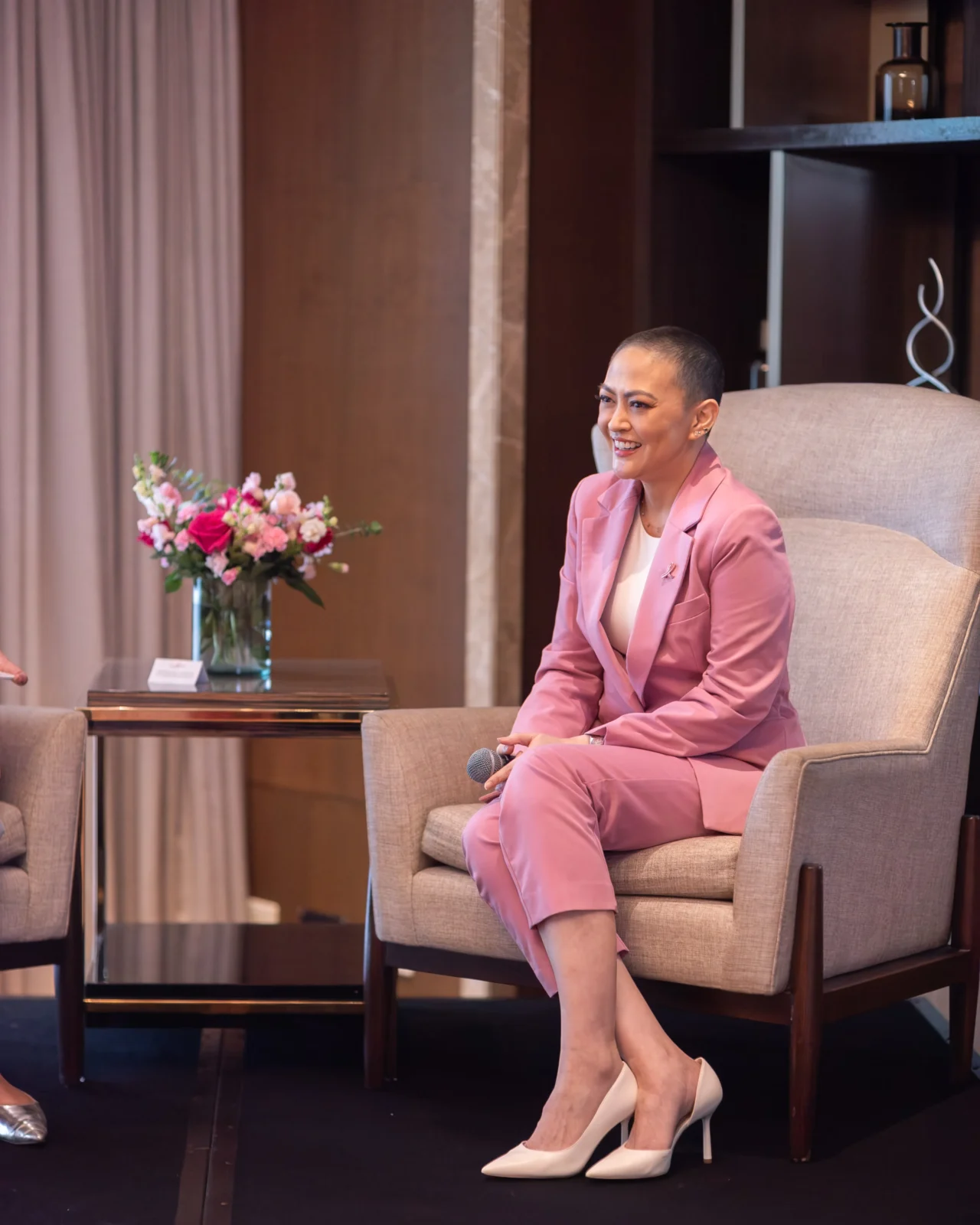
Images courtesy of Estée Lauder
“Thankfully, aside from my mom, I’m the only one who’s gotten it,” she says. At an Estée Lauder breast cancer awareness event, Litton-Kalaw’s sister, Issa, shared that she told the Litton siblings, “It ends with me. I’ll take it, so nobody else has to go through it.”
With memories of their mother’s own cancer battle looming over them, Litton-Kalaw’s became one that was shared by her entire family. Her father, siblings, and nieces, as well as her closest friends, accompanied her to chemo sessions, kept her company during long hours in the hospital, and rallied her spirits.
But instead of her mother’s memory dangling like a specter or an omen of what could possibly repeat itself, it became a source of strength for Litton-Kalaw, as she maneuvered a very similar path, one marked by a lot of uncertainty and, frankly, fear. “I don’t have kids,” she shares, “but knowing what everything feels like, I could imagine how terrifying it was for my mom to know that she would be leaving behind a husband and four children.”
The road ahead
Perhaps that is why, when asked how she—someone who had never had a mammogram or ultrasound prior to being diagnosed—would convince others to get themselves screened regularly for breast cancer, Litton-Kalaw says, “If you’re scared that it’s uncomfortable, or that they might find something, it is more uncomfortable and more terrifying to think of a future where your loved ones don’t have you in their lives. If you detect it early, you can do something about it. Early detection saves lives.”
Litton-Kalaw’s own future, admittedly, is still colored by a few shades of uncertainty. She is on hormone therapy, taking oral medications, and is being monitored for the next five years, to make sure she stays cancer-free, so she can be declared in remission. She isn’t out of the woods just yet. “You don’t go through something like this and come out the same person. My life will never be the same again,” she shares. “Physically, this is no longer as taxing as going through chemo, but emotionally, when the gravity of the situation hits, it really hits. I try not to think about it, and just live my life.”
But at this point, there is life, and there is a future, and for this warrior, Cesca Litton-Kalaw, there is another day to fight for herself and those she loves.
Frequently Asked Questions
Cesca Litton-Kalaw was diagnosed in December 2024 with stage 2 breast cancer. A biopsy confirmed the diagnosis after she discovered a lump in her right breast, and doctors conducted a mammogram and breast ultrasound prior to surgical consultation.
She underwent a unilateral mastectomy — surgical removal of one breast — along with the removal of two lymph nodes closest to the cancerous mass. Breast reconstruction was performed on the same day as the mastectomy.
Yes. Six weeks after her mastectomy, she completed six cycles of chemotherapy as a precautionary measure to eradicate all remaining traces of cancer. Side effects included hair loss, loss of taste, and significant physical and emotional strain.
Litton-Kalaw, who had never undergone a mammogram or ultrasound prior to her diagnosis, advocates for regular screening on the basis that early detection enables timely intervention. Her own diagnosis came after discovering a lump while changing — a reminder that self-examination and routine screening can be life-saving.
Following the completion of chemotherapy, she is currently on hormone therapy, taking oral medications, and under medical monitoring for five years to confirm she remains cancer-free before a remission declaration can be made.