


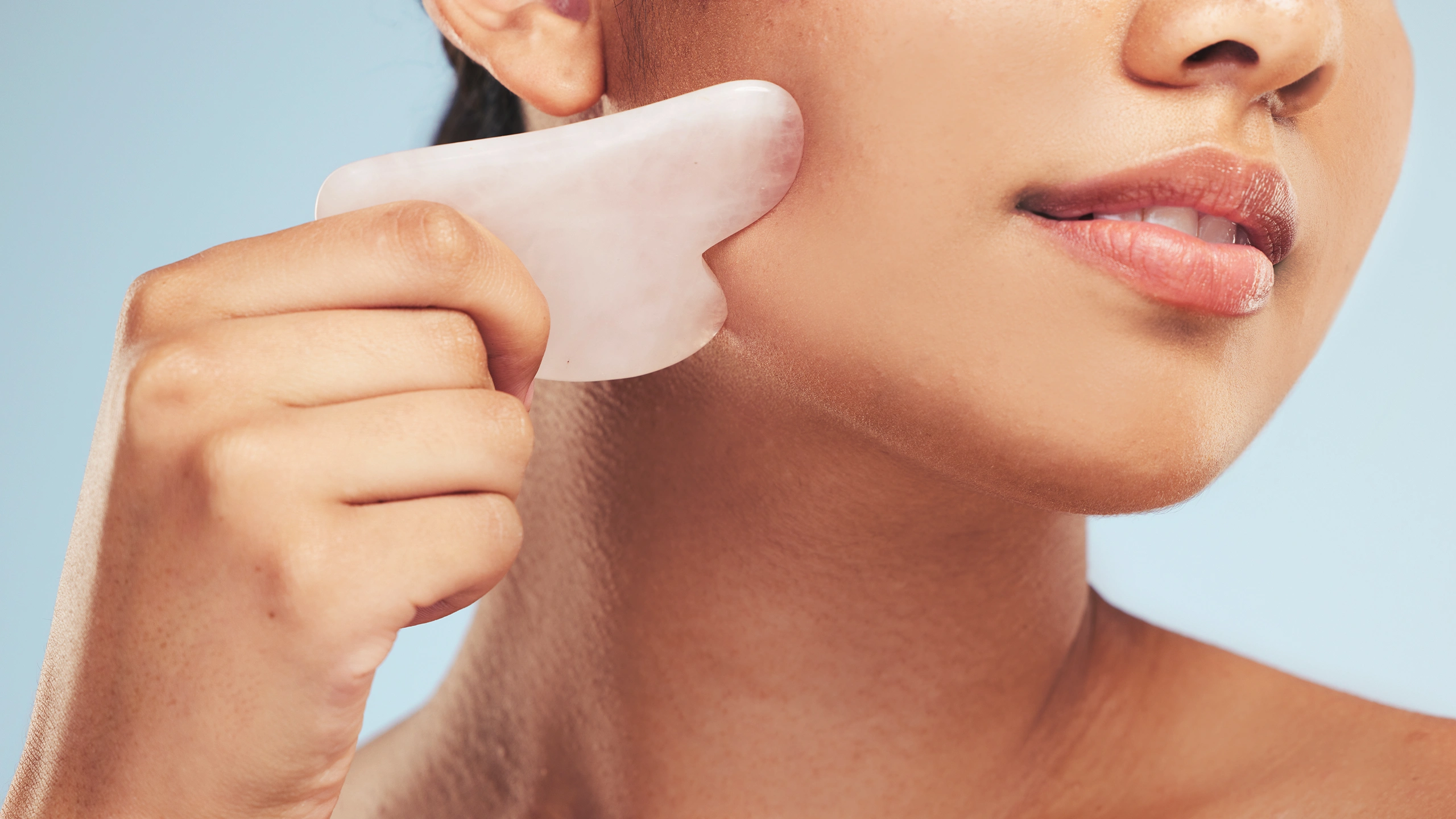
There are few things more relaxing than a beauty ritual that you choose to end your day with. And in the same vein, beginning each morning with the same little routine can be energizing, empowering, and centering.
For many people, that beauty rite that is both relaxing and centering, is gua sha. Sliding a gua sha tool across the skin, harnessing its many benefits, has become a daily ceremony for many—one that doesn’t just beautify, but aligns. Gua shas made of many different materials—metal, jade, rose quartz, or more—have come to litter both our vanities and our feeds, and if we’re being really honest, it’s a rarer occurrence nowadays to come across someone who hasn’t heard of gua sha, rather than someone who has.
But despite how commonplace the practice has come to be, there is still a lot about it that continues to elude most of us—truths and principles behind the ritual that just don’t make it to Tiktok or Reels. And since here at Allure Philippines, we place utmost value in getting beauty advice straight from the experts, we turned to Trish Tan, a traditional Chinese medicine practitioner who has earned certifications from the Ateneo Traditional Chinese Medicine program, and has been trained in Taoist Wellness Qigong & Wudang Taijiquan in Hubei, China, to find out the proper way to slide that gua sha over our jaw lines.
What is gua sha?
Gua sha, Tan shares, is actually a traditional Chinese medicine practice (TCM) that is practiced on both the face and the body. “’Gua,’” Tan says, “means ‘to scrape,’ and ‘sha’ refers to the temporary bruise-like redness that appears on the skin afterwards.”
Essentially, to gua sha is to use a “smooth-edged tool to scrape the skin,” Tan explains, “to relieve pain or tension and improve blood circulation.”
Three important points on gua sha
In discussing the right way to gua sha, Tan was adamant about tackling these three points:
The angle
Tan notes that most people actually use the edge of the gua sha and scrape it across the face, but the correct way to place a gua sha is to make it lie as flat as possible on the face. “The proper angle is at 15 to 45 degrees,” she says. “I see a lot of people hold the gua sha at a 90 degree angle, or perpendicular to the face, but it should be almost flat on the skin. This low angle ensures a gentle pressure as you glide the gua sha over the skin.”
The speed
In a nutshell: the slower, the better. “A lot of people tend to rush the process,” Tan says, “but it should actually be very relaxing. Just try to enjoy it and really slow down.”
The pressure
Light is the way to go. “Light to medium pressure is good,” Tan clarifies. “It’s not about grinding your face, but about the connection of the tool to your face.”
How to gua sha—the right way
1. Start with a clean slate.
“You want to start with a clean face,” Tan says, “so do your cleansing first.” After cleansing, Tan recommends that you keep your skin damp. “Damp skin is actually very permeable,” she explains, clarifying that when skin is damp, any product you apply is better absorbed. “After cleansing, you can get a face mist or a face, like a micellar waterMicellar WaterA no-rinse cleanser containing tiny cleansing molecules called micelles that lift away makeup, oil, and dirt. It is convenient for travel and quick removal, though many dermatologists recommend following withGo to Micellar Water Glossary, and just try to pat your face with water.”
2. Apply your product on your skin.
If you’re looking to gua sha with a face oil or serumSerumA lightweight, concentrated treatment applied after cleansing and before moisturizer to target specific concerns, such as dark spots, dehydration, or fine lines. Because serums are potent, introducing one at aGo to Serum Glossary, this is the time to apply it. Tan recommends warming the product up a bit. “You can rub it on your hand to activate it,” she shares. “Then massage it onto your face and your neck, and that should provide a good slide for the gua sha.”
3. Make sure your gua sha is NOT cold.
In traditional Chinese medicine, cold is considered the enemy. “In TCM, we discourage icing anything, because icing or cold promotes stagnant energy,” Tan explains. Gua sha, she clarifies, aims to “break up stagnant energy in the facial muscles and the tissues.” She recommends keeping the gua sha tool cool or at room temperature, or “you can even warm it.”
4. Begin at your neck.
Whatever tension is on your face, actually starts in the neck, Tan explains. “Start the gua sha practice on the neck, specifically at the back of the neck, or just below the neck. “Keep the gua sha as flat as possible, and use around five upward and outward strokes until you reach the skull,” she says.
5. After the neck, work your way to the face using upward and outward strokes.
There’s a misconception, Tan says, that gua sha is only for lymphatic drainage, but “it’s actually more than that. It targets even deeper layers of muscle and fascial tissues.” Most people stroke downwards—maybe even you. “People tend to really scrape the stagnant energy downwards towards the lymph nodes on the collarbones and the jawline,” Tan says, but she actually recommends using upward and outward strokes.
“Place it as flat as possible again, and glide it upwards and give it a little wiggle at the end. Try to go for five strokes or more,” she says.
6. Do it daily, or as often as you can.
Tan says you can gua sha daily, or perhaps two to three times per week. “You can do it in the morning, or at night,” she says. “In the morning, it’s very good for de-puffing. But at night, it’s also a very relaxing practice before you sleep.”
What using a gua sha can bring about
Tan is quick to point out that even if “sha” refers to the redness that “gua” brings about, “you shouldn’t see any red, temporary bruise-like things, and there shouldn’t be any sharp pain.” Instead, she shares that you should see “lifting, de-puffing of the face, a very sculpted jawline and cheeks, and even a brightening effect.”
And apart from the physical effects, there’s always the relaxation and centering that such a ritual should bring.
Frequently Asked Questions
The correct angle is 15 to 45 degrees — nearly flat against the skin. Most people hold the tool perpendicular to the face at 90 degrees, which applies too much pressure and reduces the gliding effect. A low, flat angle ensures gentle, even pressure across the skin surface, which is essential for the tool to work as intended in traditional Chinese medicine practice.
Gua sha strokes should move upward and outward — not downward. While many practitioners scrape downward toward the lymph nodes at the collarbone and jawline, certified TCM practitioners recommend upward and outward strokes with a slight lift at the end of each pass. The technique targets deeper muscle and fascial tissue layers, not just the superficial lymphatic system.
A gua sha tool should be at room temperature or gently warmed — never cold. In traditional Chinese medicine, cold is considered to promote stagnant energy, which is the opposite of what gua sha aims to achieve. The practice is designed to break up stagnant energy in the facial muscles and tissues, and applying a cold tool works against this principle.
Gua sha can be practiced daily or two to three times per week, depending on your routine. Morning sessions are particularly effective for de-puffing, while evening sessions serve as a relaxing pre-sleep ritual. Consistency — rather than frequency alone — is the key factor in achieving visible results such as lifting, jaw definition, and a brightening effect.
Begin with a clean, damp face — damp skin is more permeable and allows better product absorption. Apply a face oil or serum after cleansing, warming the product between your palms before massaging it into the face and neck. This provides the slip needed for the gua sha tool to glide smoothly without dragging or irritating the skin.
Lia Cruz
Lia Cruz is a broadcaster, presenter, and writer whose expertise spans lifestyle, travel, climate, and women’s issues. Drawing on nearly two decades of experience in television and live media, she brings thoughtful storytelling and a people-first perspective to every feature. At Allure Philippines, she writes profile features that uncover the stories behind the people shaping beauty, culture, and society.
- KEYWORDS
- gua sha
Latest Stories


You might also like


To provide a customized ad experience, we need to know if you are of legal age in your region.
By making a selection, you agree to our Terms & Conditions.