

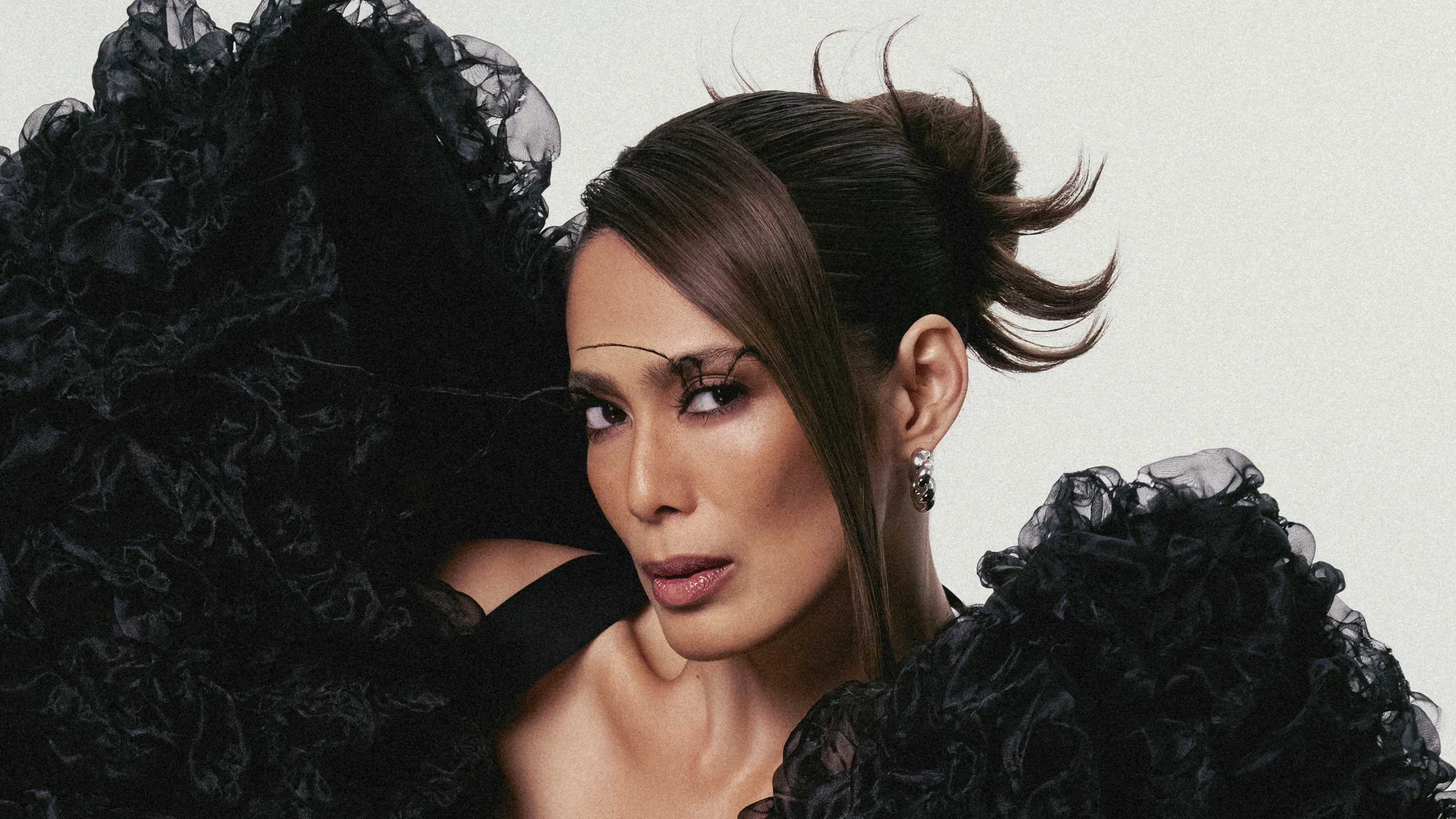
Angel Aquino froze when she saw the message from Senator Risa Hontiveros’ office. The acclaimed actress barely had time to process it before a link appeared on her phone.
Do you know that you have this AI of yourself in a porn video? the message read.
Aquino couldn’t even bring herself to click the link. Just the thumbnail was enough to make her stomach turn: it was her face, on a body that was not hers. It was jarring, violating, and infuriating, to say the least.
For Aquino, a public figure whose work spans acclaimed films, television, and advocacy, being reduced to a digital object felt like an assault on everything she stood for. “These things are so wrong. First of all, there is no consent, and it’s manipulated so they can just do it to anybody,” she says, her voice firm, almost shaking with controlled anger.
The personal impact
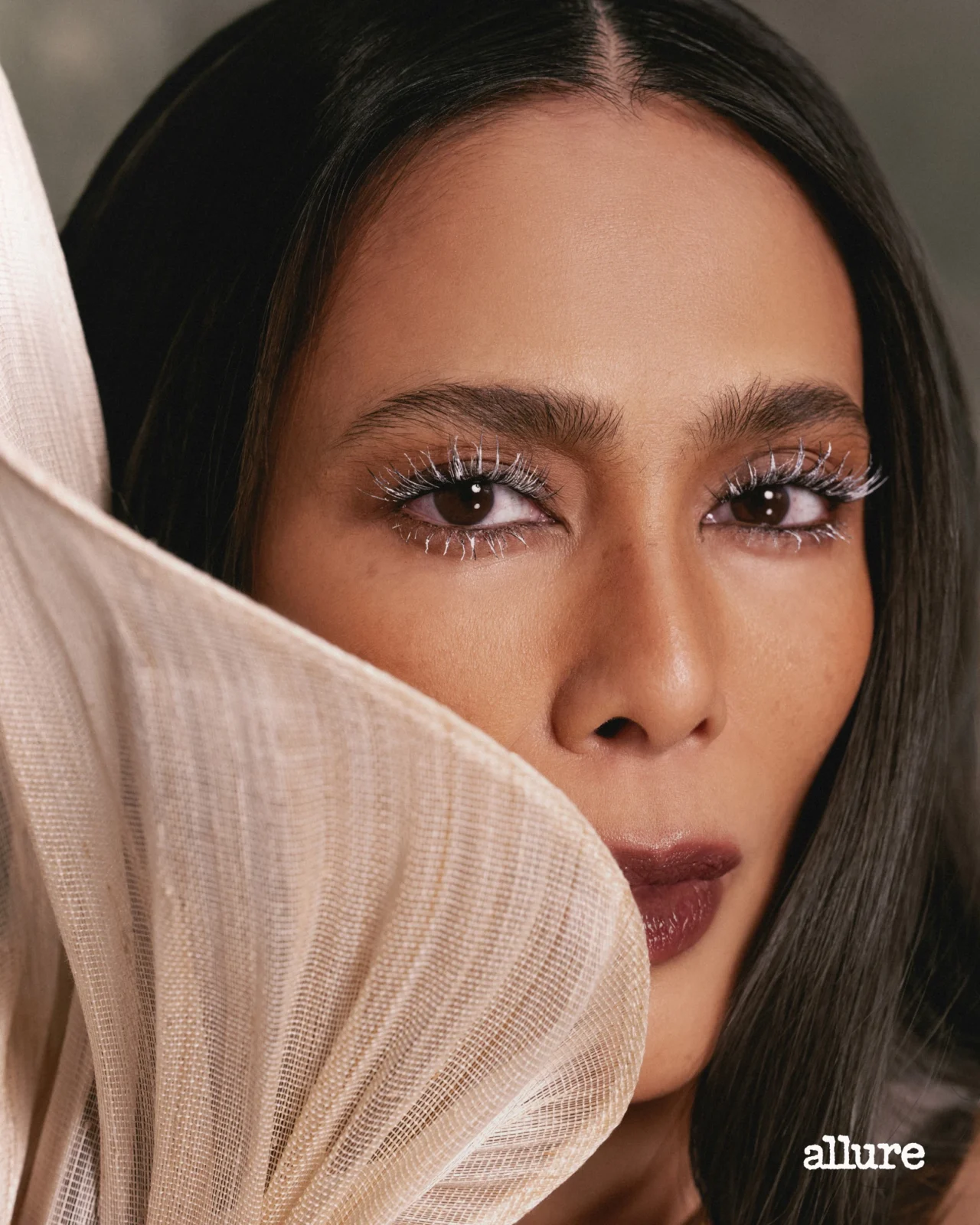
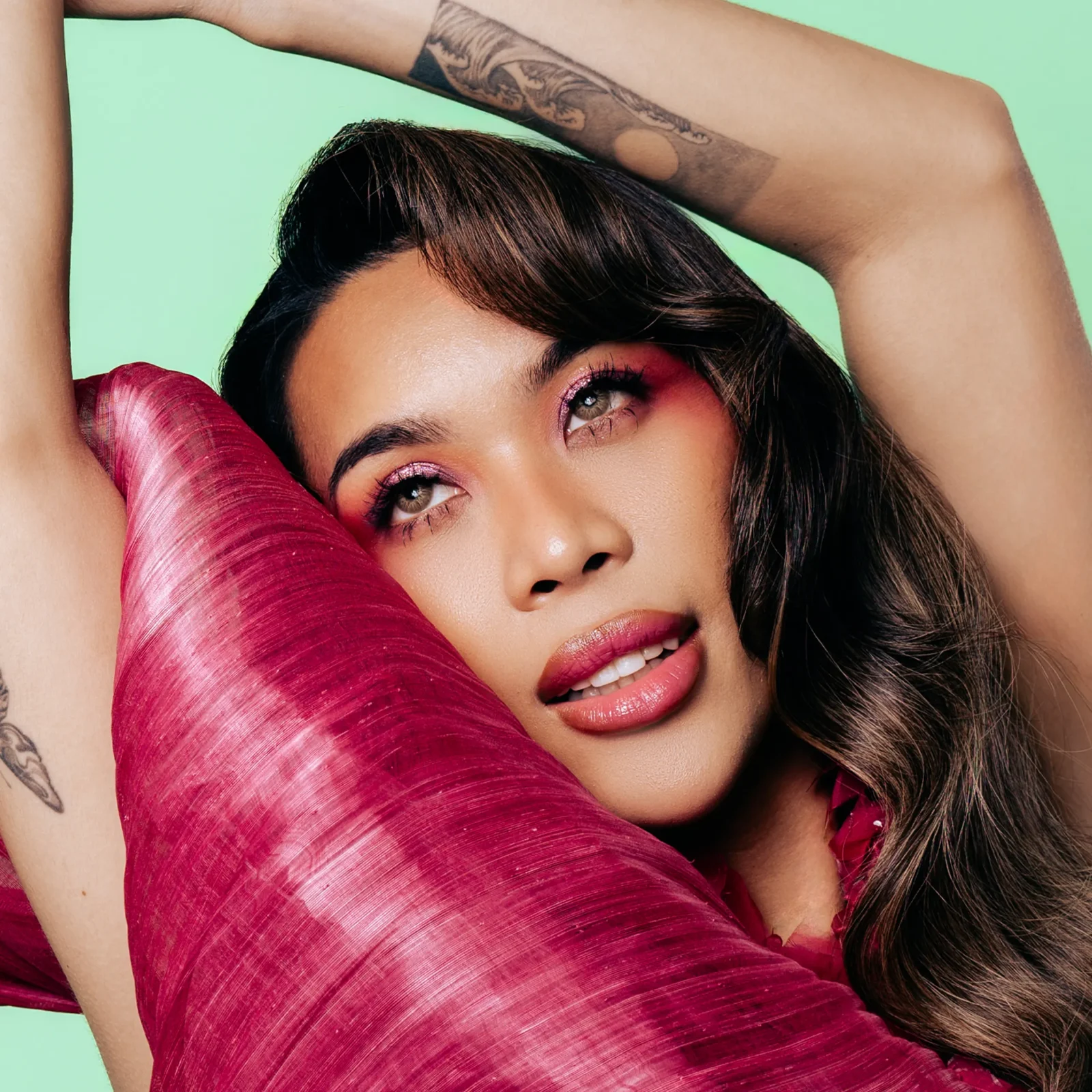
Photographed by Charisma Lico-Santos. Aliane Tan Tethered Grace. Maic Atellier Pleated Bra. Ditta Sandico Banaca Wrap.
The emotional toll was immediate. Aquino says she was stricken by disbelief and indignation. “At first, I was thinking, how did they find me? What made them think to use my face for a video like that?” she shares.
The incident forced her to question not only her public image but also societal perceptions of women. She had never presented herself in a sexualized way, neither in her films nor in her public appearances, yet her image was co-opted without permission.
But Aquino knew very well that it wasn’t an isolated incident. Instead, it was a symptom of a larger problem. Other prominent figures had also had their likenesses manipulated into explicit content. “It’s unfair. It’s bullying. It’s just… stepping all over you,” she says.
Visibility, boundaries, and the cost of being public
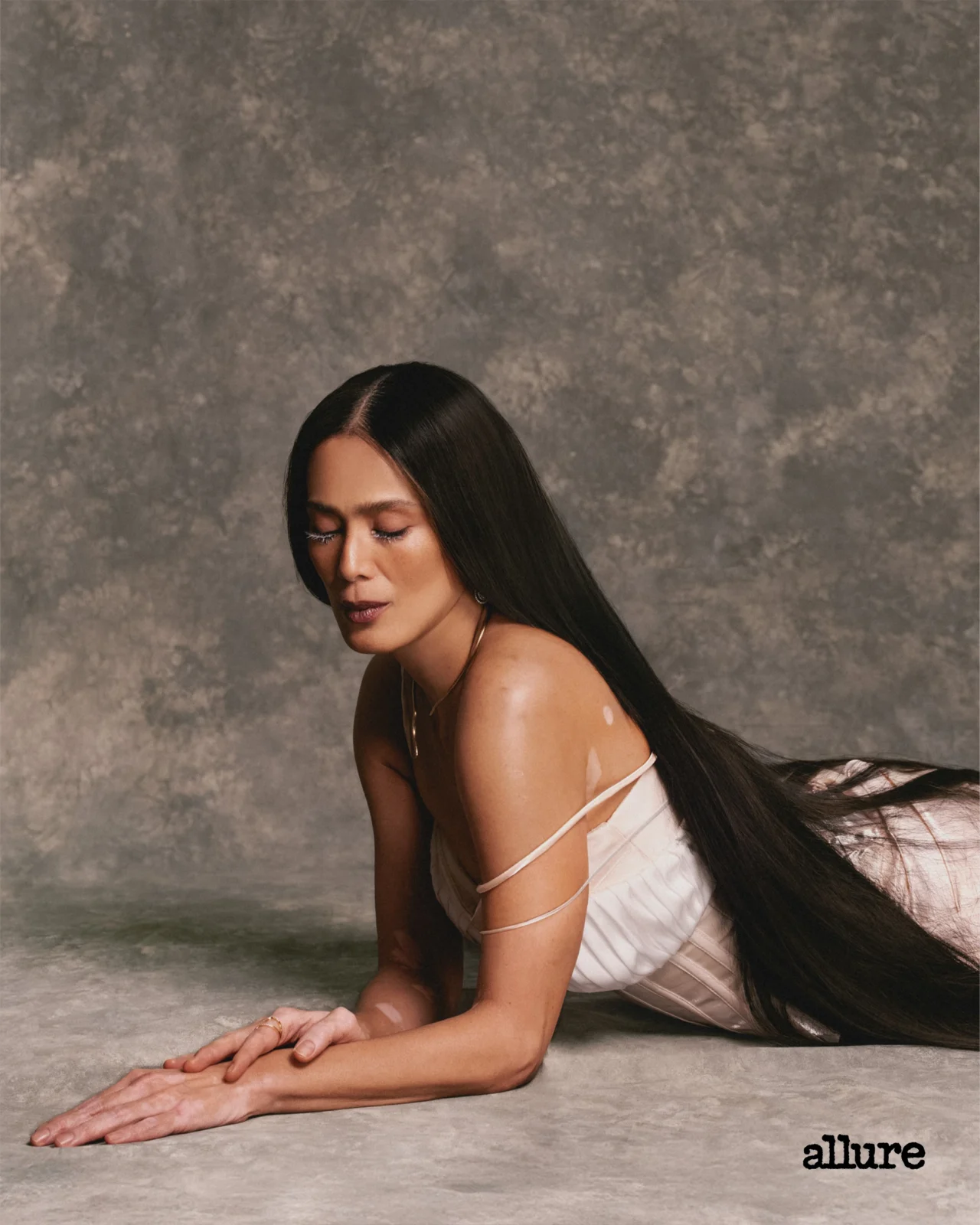
Photographed by Charisma Lico-Santos. Aliane Tan Tethered Grace. Maic Atellier Pleated Bra. Ditta Sandico Banaca Wrap. Miladay Dangling Diamond Earrings and Diamond Ring. Kalima Arts Liuag Brass Choker.
Being a public figure has its inherent trade-offs. That’s a fact that Aquino admits. Exposure invites scrutiny, and with it, potential exploitation. But she draws a line.
Public visibility does not erase personal boundaries, she demands.
“You put yourself out there, definitely people can just tear you apart and say things about you. I mean, that’s just part of being a public [figure]. But I hope there are bounds,” she says.
Photos, videos, or interactions, no matter how casual, should never be twisted into tools for objectification or malicious content. “I hope that people understand that if they were in our shoes, they would also wish that they are also protected.”
Turning violation into advocacy
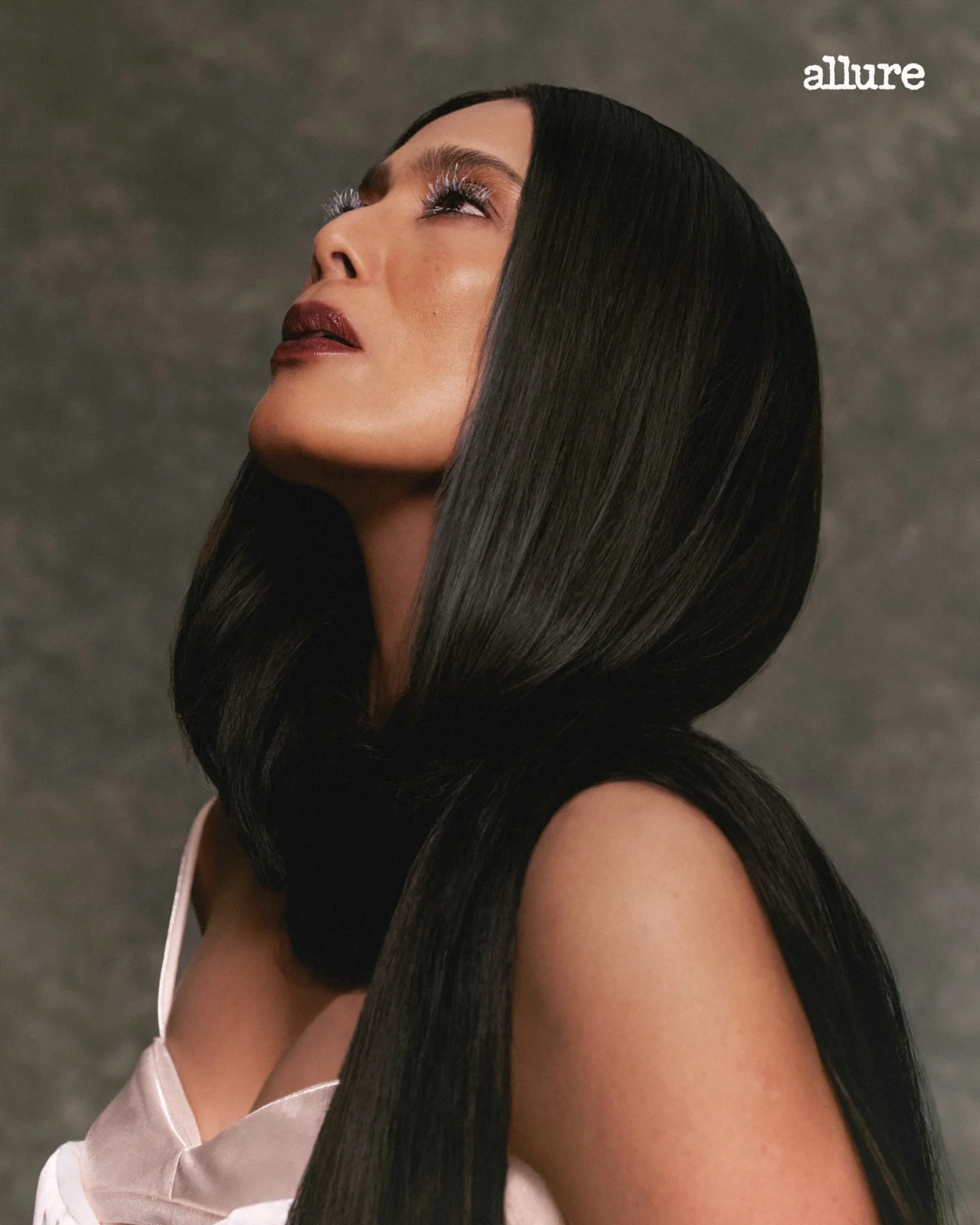
Photographed by Charisma Lico-Santos. Aliane Tan Tethered Grace. Maic Atellier Pleated Bra. Ditta Sandico Banaca Wrap.
Aquino, knowing that she had a platform, did not retreat. She took a stand. She spoke publicly and used her voice to raise awareness about the rampant proliferation of AI-generated sexual content.
She spoke during a Senate hearing on proposed measures addressing the use of artificial intelligence in deepfake pornography. There, before lawmakers and advocates, she put language to what so many women experience but struggle to articulate: that this is not harmless technology, but a form of violence.
“I had to say something because it wasn’t something that I wanted to take sitting down. I wanted to say that, ‘Hey, this is not okay. I am not okay with this,” she stresses. “Thankfully, I was given a platform to speak and be heard by a lot of people because this is rampant. It’s proliferating. It’s being done here, [and] being done everywhere.”
Her response shifts the focus from personal shame to justice and accountability, sending a message to other women: Don’t be afraid to reclaim your autonomy and don’t feel ashamed–there’s absolutely nothing to be ashamed of.
Her outrage extends to those who profit or thrive from such violations. “They should be arrested. They should go to jail. It’s abusive. Perversion is one thing, and it’s another thing to earn off of it. It can destroy somebody’s mental state and emotion,” she says, leaving little ambiguity about her stance.
Aquino also questions the cultural forces behind such exploitation. “Some men are just perverts. They can’t be content with their imagination anymore. Some people say it out loud. Why?” she asks.
“That body is used to nurture and raise good people and gift them to the world. It’s not for pleasure,” she emphasizes, situating her experience within a broader feminist critique of objectification.
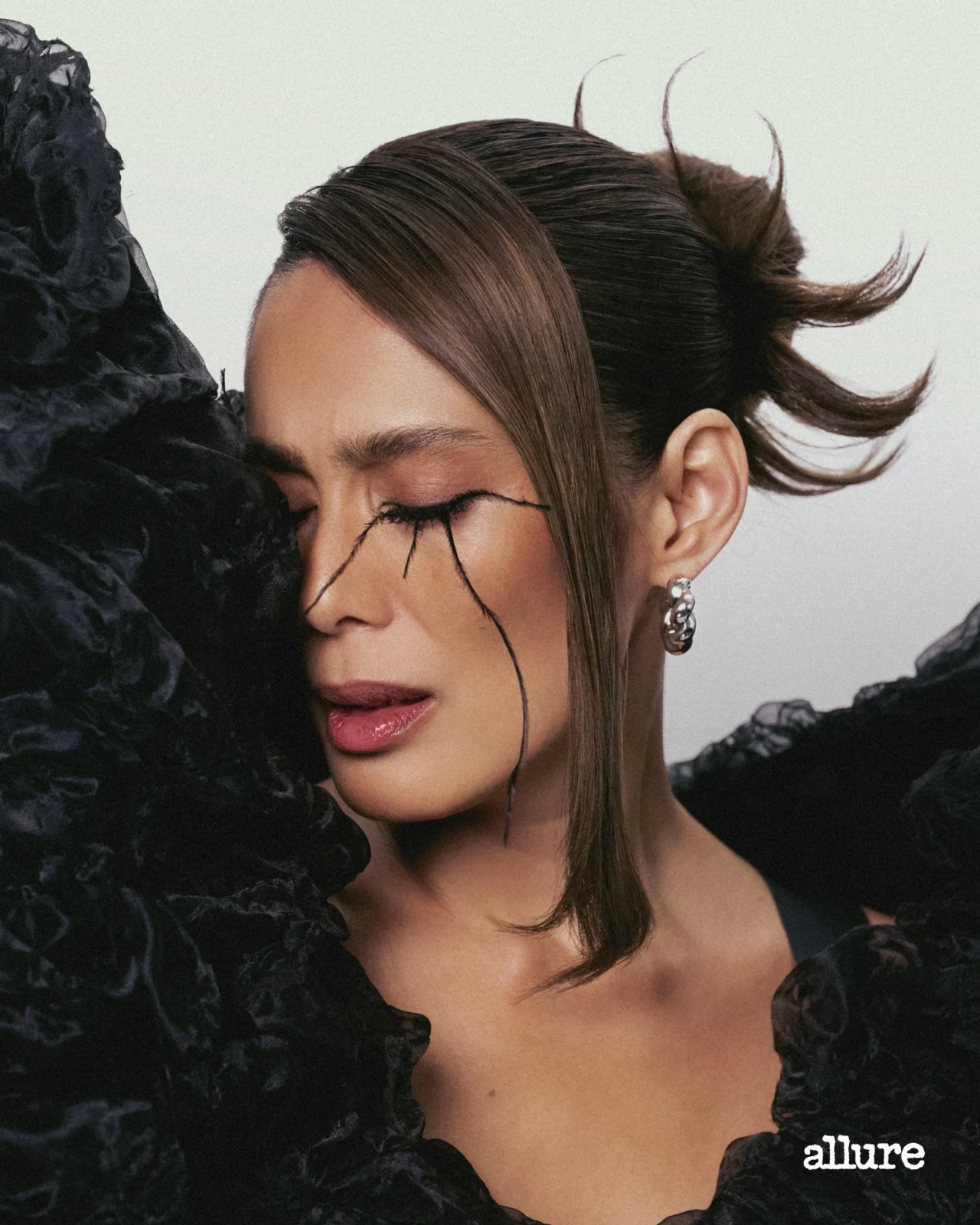
Photographed by Charisma Lico-Santos. Lara Datinguino Fatal Destruction Top.
When asked how women can protect themselves, she admits she doesn’t know how to answer, because in reality, it was never the victims that must do the changing. It is the perpetrators, and more importantly, the culture that makes space for them. It’s the root problem that continues to target women and sexualizes, and victimizes them.
“Why?” she asks, the question hanging heavy before she repeats it. “Why do you allow these things to happen?” It’s not just a question directed at perpetrators, but at a culture that continues to tolerate, even normalize, the objectification of women’s bodies–now amplified by technology that makes violation faster, easier, and harder to trace.
“I mean, you have a mother. We all have mothers. We all come from mothers,” she continues, grounding her argument in something deeply human, almost instinctive. For Aquino, this isn’t just about digital ethics, but about forgetting the fundamental truth of what a woman’s body is and what it has been for.
“That body is used to nurture and raise and work hard to raise good people and gift them to the world,” she says.
She breaks it down further, deliberately, almost as if reminding not just her audience, but the world. “Those breasts are used to nurture babies and make sure that they have immunity,” she says. “And the vagina is used to birth you, to birth everyone.”
There is no sensationalism in the way she says it, only clarity. A refusal to let the female body be reduced to spectacle when its reality is far more powerful, far more essential. “So what’s the big deal?” she adds, almost incredulous now. “Have some respect–respect for the female body, because it has its purpose and not just for your pleasure.”
At that moment, Aquino reframes the entire conversation. What is often dismissed as “just content,” “just AI,” or “just a joke” is, in reality, part of a much larger pattern, one that strips women of agency and rewrites their bodies into something consumable.
Empowering women online
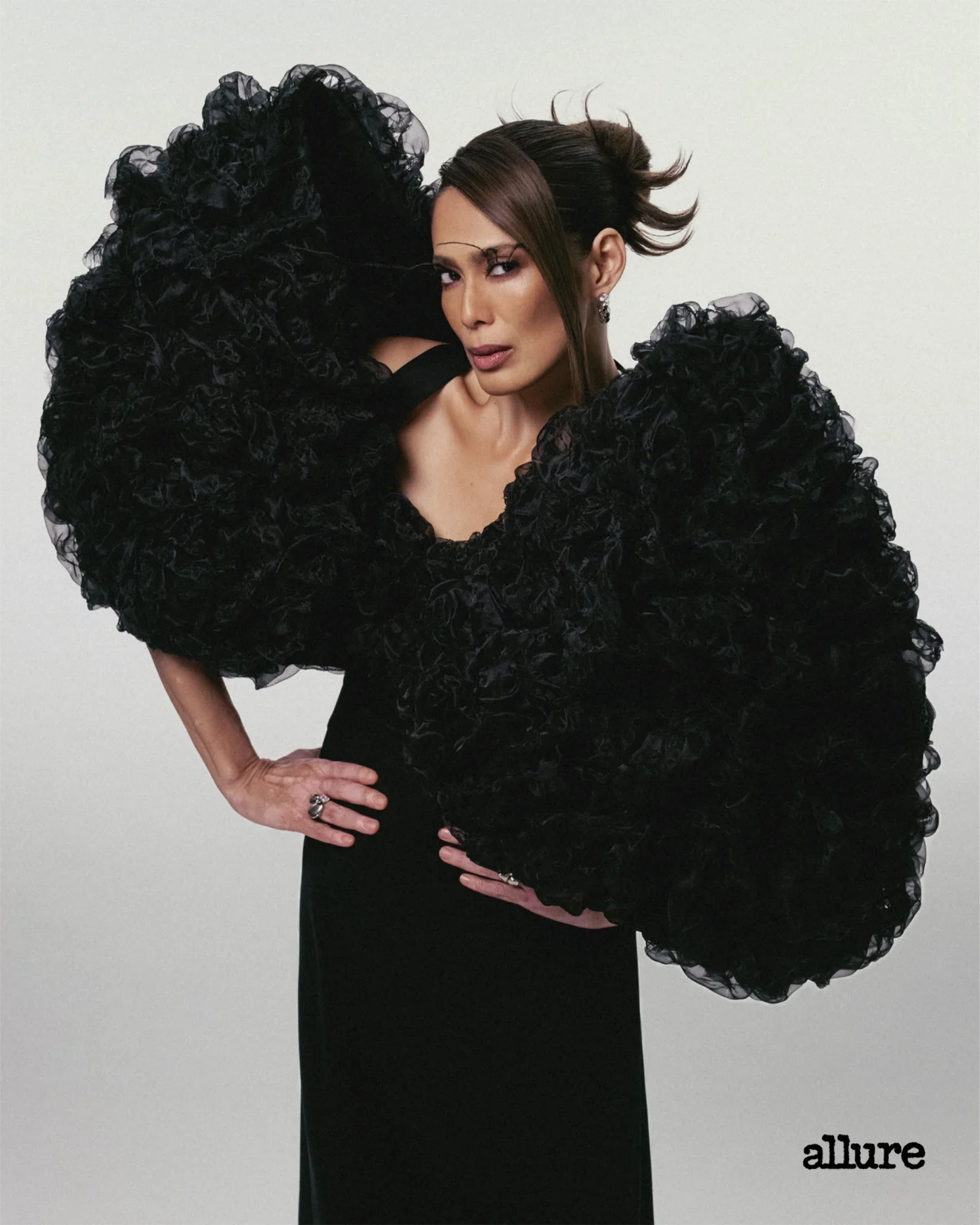
Photographed by Charisma Lico-Santos. Lara Datinguino Fatal Destruction Top. Ditta Sandico Tube Dress.
Still, from this experience, Aquino is able to distill some guidance for women navigating digital spaces. Speaking up, setting boundaries, and demanding consent are acts of empowerment. “It’s okay to say, ‘No.’ It’s okay to say, ‘I am not okay with this,’” she reminds other women..
Respect for personal and digital space is essential: “Don’t feel that you owe them anything. Don’t feel that they own you. They don’t. You own you. You’re the only person who owns your body, your mind, your heart, your emotions,” she continues.
For Aquino, reclaiming agency over one’s image is inseparable from feminism: a declaration that women’s autonomy, dignity, and safety are non-negotiable.
Advocacy with grace
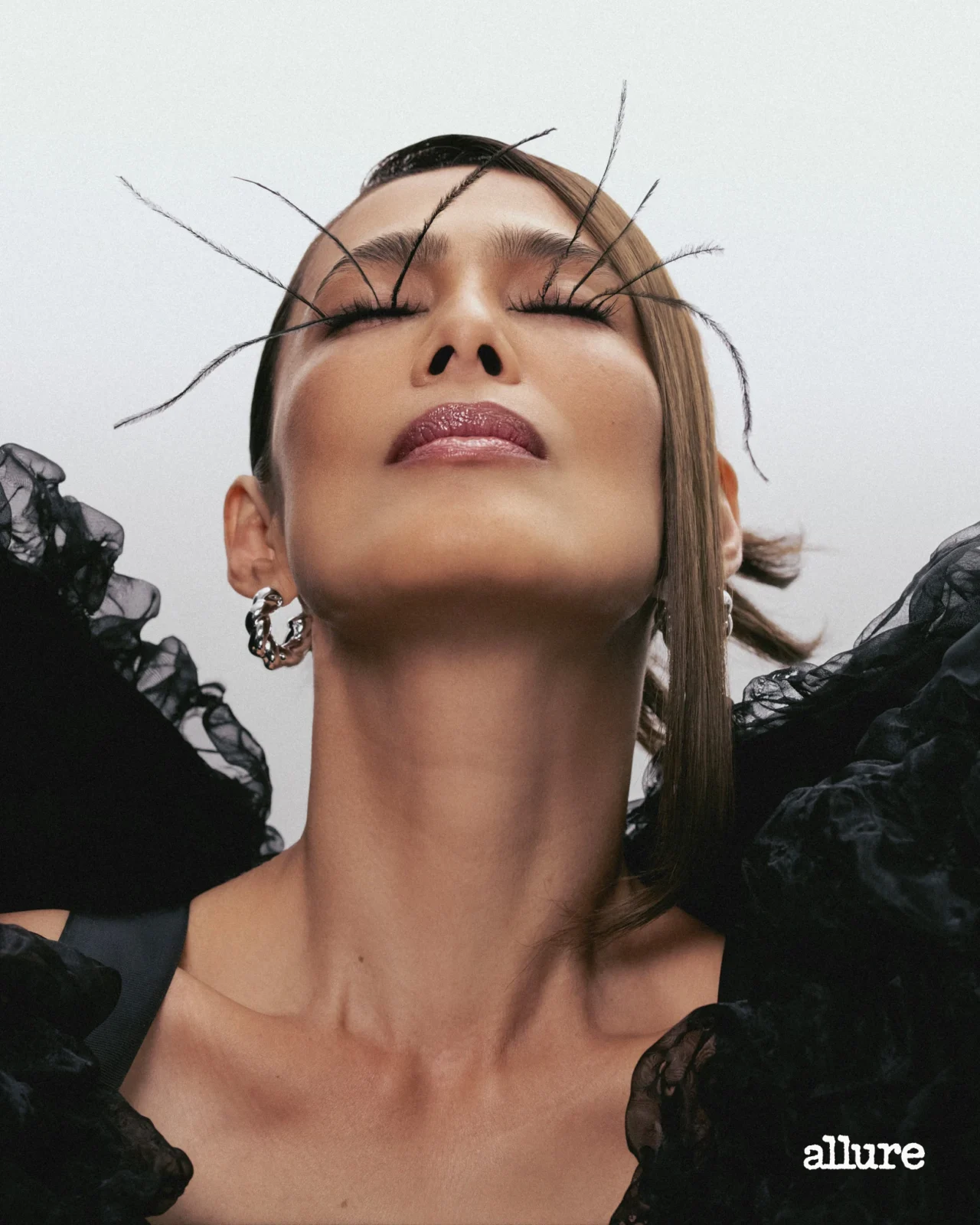
Photographed by Charisma Lico-Santos. Lara Destruction Fatal Destruction Top.
In the glam room, preparing for the next layout, Aquino sits in the makeup chair surrounded by an all-women team Allure Philippines formed for this very special shoot: makeup artist Xeng Zulueta, hairstylistHairstylistA beauty professional who specializes in cutting, coloring, styling, and caring for hair, combining technical expertise and creativity to enhance individual style, confidence, and self-expression.Go to Hairstylist Glossary Reese Roque, editor-in-chief Rissa Mananquil Trillo, and the rest of the Allure Philippines team. The conversation quickly turns to a familiar topic–the ways women become targets of such violations, and how generative AI has only intensified a problem that has long been embedded in society.
Because let’s be honest: even without the advanced technology, every woman in that room knows that objectification and sexualization of women are not new. They’ve always been present, woven into culture as if they were normal, casually dismissed, and too often endured.
It’s not normal. It never should be. Aquino doesn’t soften when she says it. If anything, her conviction is much more firm now.
What happened to her may have begun as a violation of her autonomy, but it did not stay that way. She refused to let it.
Art direction by Nicole Almero. Beauty direction by Leira Aquino. Photography by Charisma Lico-Santos, assisted by Yhana Imutan, Erwin Arda, Antonio Baylon Jr., Mark De Castro. Makeup by Xeng Zulueta. Hair by Reese Roque. Styling by Gee Jocson, assisted by Kassandra Gandionco and Vince Avisado.
Frequently Asked Questions
AI deepfake pornography uses generative AI to superimpose a person’s face onto explicit content without consent. Legal advocates and lawmakers classify it as a form of digital sexual violence because it violates bodily autonomy, causes psychological harm, and is produced and distributed without the subject’s knowledge or agreement.
Aquino testified before the Philippine Senate at a hearing on proposed legislation addressing AI-generated deepfake pornography. Rather than staying silent, she publicly named the experience as a violation and called for criminal accountability for those who create and profit from non-consensual AI sexual content.
As of the time of this feature, proposed Senate measures were under deliberation. Aquino’s testimony contributed to the public record supporting legislation. Existing laws on photo and video voyeurism and online sexual abuse may apply, but advocates argue dedicated AI deepfake legislation is necessary given the scale and speed of AI-generated content.
Public visibility does not eliminate the right to consent. While public figures accept scrutiny of their professional work, they retain legal and ethical rights over how their likeness is used — particularly in sexual or explicit contexts. Non-consensual use of a public figure’s image in AI-generated content constitutes a violation regardless of their public status.
Document the content immediately without clicking or sharing further. Report to platform providers using non-consensual intimate image (NCII) removal tools. File a complaint with the Philippine National Police Anti-Cybercrime Group or the Department of Justice Office of Cybercrime. Seek legal counsel — existing cybercrime and anti-photo voyeurism laws may provide recourse while dedicated AI legislation is pending.