What’s in a Scent? The Truth About Methanol in Perfumes
With reports of high levels of methanol detected in locally sold perfumes, Allure Philippines investigates, speaking with experts to unpack what this means for consumers.


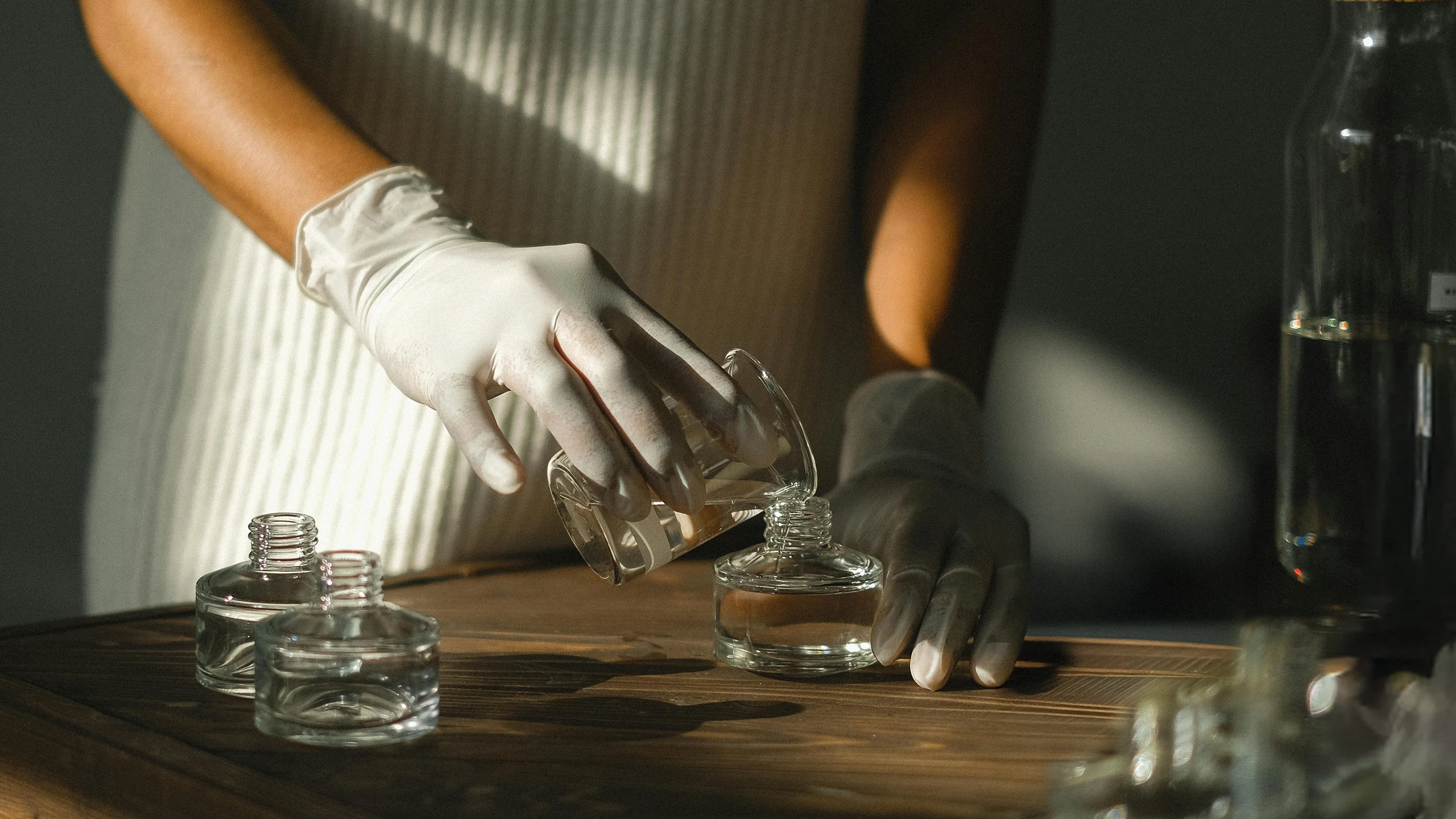
When I was an intern in a hospital laboratory, the first thing they taught us was lab safety. Lab gowns on at all times, masks worn properly over our noses, gloves always on. Bottles lined the lab shelves, each marked with symbols we had to memorize. A skull meant toxic. An ‘X’ meant a harmful irritant. We learned to read danger before we even touched anything. Some warnings too were impossible to miss because of the smell. If our eyes started to sting and a sharp, suffocating scent hit the back of our throat, we knew it was formalin. But what my experience in the lab didn’t prepare me for was this: danger does not announce itself that way anymore.
Now they are fragrant and familiar, like freesias, citrus, and musk. The kind of notes you’d recognize from your favorite scent. Yes, the ones we spray on our wrists without a second thought, then rub it some more behind our ears. The smell that lingers and sticks to our favorite shirt even after a long day.
Recently it has come to light that perfumes, especially from local purveyors, have high levels of methanol. And that’s what makes it unsettling. Because outside the lab, there are no hazard symbols, no skulls on the label—just mist in a glossy bottle. Because of this, I reached out to my college lab instructor and a local fragrance industry expert to find out what exactly is happening.
What is methanol?
According to Pharmaceutical chemist Adrien Jacinto, RPh, MS., who teaches Pharmaceutical Chemistry and Toxicology at the University of Santo Tomas, “Methanol is the simplest form of alcohol. It is a colorless, flammable liquid.” It’s commonly used in laboratories, industrial processes and pharmaceuticals. He also shared that methanol is difficult to distinguish by smell alone.
The important part: methanol is toxic. It is not something that should be intentionally used in cosmetics or fragrances. “We regard it as an irritant. It’s a poison,” he says.
So how does it end up in some locally sold perfumes? The short answer, it’s not supposed to, but it can slip in. While methanol isn’t naturally a fragrance ingredient, sometimes it can show up as an impurity, or as a denaturant added during production to make alcohol undrinkable.
What went wrong?
For Filipino perfumer Renato Lopena Jr., who trained at the Grasse Institute of Perfumery in France and is a pledger to the Perfumery Code of Ethics, the recent reports weren’t exactly shocking. “I am not surprised. It is something that I know that is bound to happen if some brand owners deal with unreputable suppliers. And, sadly, it blew up like this,” he says, pointing to the reality of sourcing in the local industry. “I also know the unethical practices of some suppliers who taint ethanol and add methanol in order to cut costs and to not pay excise tax.”
As founder of the homegrown fragrance brand Wren Atelier, he shared that his company has put a system in place where every batch of sourced alcohol is tested. He emphasized how important batch testing is, explaining that brand owners cannot rely solely on documents. Even if a supplier is paying excise tax, it does not guarantee that the alcohol is free from methanol.
What should be in the formula instead of methanol?
Supposedly fragrances should use ethanol, not methanol, for good reason. Jacinto explains that “ethanol acts as a base to dilute fragrance oils, helps preserve the formula, increases the diffusibility of the scent, and gives that light, cooling effect when you spray it on.”
He also added that ethanol is relatively safe, even common. It’s an alcohol the body can process, for example, your favorite wine. “Chemically speaking, ethanol and methanol only have one carbon difference, but this difference has a strikingly great impact on their safety and tolerability.”
Because of this, strict limits are in place. The EU regulations as well as the ASEAN Cosmetic Directive has set parameters for the amount of methanol as a denaturant, stating that the acceptable level is at 5 percent or less. The concern now is that some local perfumes contain far more than that, with levels of as much as 25 to 65 percent.
What are the dangers of methanol?
Once it enters the body, methanol breaks down into toxic substances such as formalin (yes, the same one used in embalming) and formic acid. With more serious or systemic exposure, formalin becomes carcinogenic, meaning it may increase the risk of cancer and, in severe cases, lead to organ failure and death.
“For its final metabolite, formic acid, this is actually the metabolite of your methanol, which is toxic to your eyes, leading to blindness.” According to Jacinto, “We usually describe it in toxicology as a snowstorm-like visual disturbance, like the person is in a snowstorm because of the presence of persistent white hazy vision in the affected individual.”
In cases of methanol toxicity, Jacinto explains that treatment for accidental ingestion may involve administering ethanol. “We give them beer, we give them wine or something that contains ethanol because both will compete for the metabolism in the body. So usually our body favors ethanol.”
He adds that poison control centers, such as those at the Philippine General Hospital, can provide specific antidotes like fomepizole, which helps prevent methanol from converting into more harmful metabolites. “So we actually have a drug for that,” he notes.
What to do with the contaminated perfumes now?
If you’re still holding onto any fragrances tagged with methanol, Jacinto’s advice is to return it, but if it is not possible, dispose of it. “In households, what they can do is to dilute it with large amounts of water before draining it in the sink, to have a lesser impact on our environment.”
Beyond safety, this issue has also reshaped consumer behavior. Lopena notes that trust in local brands has taken a hit, with some consumers now leaning toward international brands instead. “Actually, it really has a big impact on the local fragrance industry. Ever since this issue came about, consumers now have trust issues across local brands. They have that skepticism and that’s rather sad.”
How can we trust again?
According to Lopena, the issue doesn’t lie solely within the industry, there also needs to be adjustments on the regulatory side, particularly in how the FDA handles these situations. He revealed that the current process for perfume notification is relatively straightforward, often limited to simply putting the formula, with little else required.
“How to regain trust? It’s full transparency from the alcohol that you use until the ingredients that are in the fragrance.” Lopena remarks. Rebuilding that trust won’t happen overnight. It requires more than just meeting minimum standards, it now means doing what is right in the first place—testing rigorously, being transparent about sourcing, and proving, not just saying, that products are safe.
Both Jacinto and Lopena underscored that strong quality control is necessary to address the root of the issue. It’s a level of diligence they believe should be standard. Because once a product reaches the shelf, it’s already too late to question what went into it.
A scent is deeply personal and intimate. It sits on your skin and becomes part of your personality, your memory. I know this because I associate specific moments in my life with a scent, or I remember someone special through them. Spraying something that is supposedly meant to comfort us should never come with doubt. And fragrance, like trust, should never feel uncertain.