Closing the Gap: Everything You Need to Know About Diastasis Recti
If you’re battling a bulge in your tummy that never seems to go away—and experiencing pain and other symptoms listed below—you may want to check for this abdominal condition.


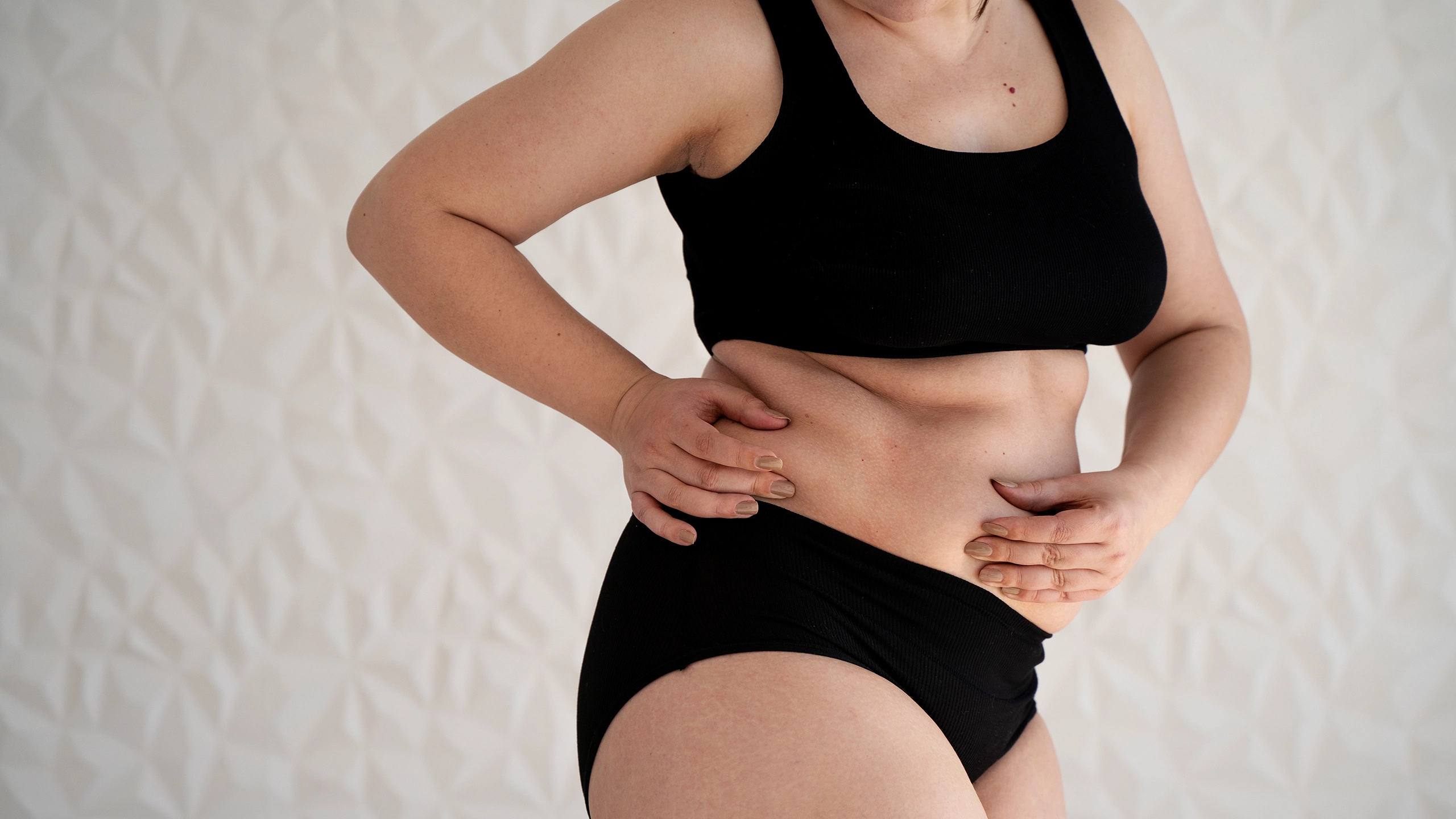
“Your gap is around two and a half fingers wide,” the physical therapist told me, pressing down hard above my belly button with two of her fingers to feel the rift, while I contracted my soft, squishy core in a crunch. I was nine months postpartum after my second child, and in my first session with my physical therapist, or PT, in an attempt to get back in shape after my second C-section.
My “gap” was the breach in my abdominal muscles, caused by the pregnancy, that was giving me that “soft, squishy core.” The pregnancy had overstretched my abdominals, creating space in the middle, where there was supposed to be none. Nine months after giving birth, I still had a jiggly bulge in my belly, pain in my lower back (which I previously never had), overall weakness in my formerly fit body, and, if I was being honest, a pretty poor self-image and sense of self.
That first session confirmed what I already suspected: that I had diastasis recti, or DR or DRAM, as it is otherwise called. My PT measured the width of the separation in finger breadths (“two and a half fingers wide”), and reassured me that, with the proper program, we could “close the gap,” strengthen my core, and make my back pain disappear.
What is diastasis recti?
Diastasis recti is a very common condition that pregnant or postpartum women may already be familiar with. According to licensed physical therapist Charmaine Geronimo, PTRP, RPT, founder of Re-Hub Physical Therapy Clinic, who is certified in advanced pelvic floor rehabilitation, over 60 percent of women experience it after pregnancy.
Although awareness of this condition is slowly growing, pelvic floor therapy or rehab—which aids in recovery from diastasis recti—is still not widely practiced here in the Philippines, unlike in other countries, Geronimo says.
To break down this condition, Allure Philippines spoke with Geronimo, and with OB-GYN and pelvic floor specialist May Anne Tabaquero, MD, FPOGS, FPSURPS of St. Luke’s Medical Center. Read on for more.
Who is at risk for it?
Down the center of your abdomen runs the linea alba, a fibrous or fascial attachment, to which the two halves of your rectus abdominis muscles are attached. Diastasis recti happens when these two halves of muscles separate from the linea alba, the central tendon. “You will notice that the area where your abdominal muscles is stretched out,” explains Dr. Tabaquero, “and the outlines of the muscles are far in between each other.” This separation is the “gap” that my PT felt with her fingers during that first session.
The separation usually takes place because of some sort of weight or pressure. In pregnant women, it’s obviously the presence of the fetus you’re carrying. But pregnant women aren’t the only ones at risk of suffering from diastasis recti. “Those who are overweight or obese can also suffer from it,” Dr. Tabaquero explains.
Geronimo adds that anyone who is obese can also suffer from it, including men. “Even the older population,” she says, “because as we age, the abdominal muscles get weaker. Also those who do heavy lifting, because if your muscle is weak, and you’re overloading it, that can cause separation. So really, everyone is a candidate for diastasis recti, because we’re talking about the abdominals, which we all have, getting overstretched.”
What does diastasis recti do to the body?
Dr. Tabaquero says that diastasis recti, especially in serious cases, can cause the following:
- pelvic pain, which some patients describe as “heaviness,”
- back pain,
- urinary incontinence or the loss of bladder control (read: leaking urine),
- fecal incontinence, which is the loss of bowel control (as in, bowel movements any time, any place), and
- umbilical hernia, which happens when part of your intestines bulge through that space, meaning bowels may become trapped in that hernia.
Geronimo also adds that problems with the pelvic floor area, may also lead to problems with sexual function.
If diastasis recti goes undiagnosed and untreated, it can make the symptoms or effects worse, according to Dr. Tabaquero. “It can go from occasional pelvic heaviness and back pain, to urinary incontinence or leaking, to more persistent and debilitating pain.”
How can I tell if I have diastasis recti?
One of the main signs that your abdominal muscles have separated is, according to Geronimo, “bulging in your belly.” And we’re not just talking about a bulge that tells the world you’ve had a double patty cheeseburger meal with a large side of fries and a soda—or maybe two—for lunch. Instead, it’s a constant bulging or pouching, which some physical therapists call “doming.”
As for how physical therapists determine whether you have a gap, and how wide it is, it’s all about pressing those fingers down, as was done to me. “PTs really measure it in terms of fingers,” says Geronimo. “We check above and below the belly button. Usually, we’ll use two fingers, or two finger breadths, and press down one inch, then two inches, then three inches above the belly button. Then again, one inch below, two inches below, then three inches below. We measure how many fingers will fit in the gap.”
Other indicators are back pain, pelvic pain, and a leaky bladder. If you experience any of these, schedule a visit to your OB-GYN first to rule out any other condition.
Is it possible to prevent diastasis recti from happening?
It is, in fact, possible to prevent diastasis recti, even in pregnant women. Prevention involves a really, really strong core. “Proper core strengthening has to be done even before and during pregnancy,” Dr. Tabaquero specifies, adding that it’s also important to have a good diet to prevent obesity.
Before anything else, Geronimo stresses that pregnant women should first get clearance from their doctor to exercise. “If you have hypertension, preeclampsia, bleeding, or other conditions that your doctor can check for, you won’t be allowed to exercise.”
Once you’ve been cleared, Geronimo suggests several exercises. “You can do breathing exercises in the first trimester, plus pelvic tilts, and pelvic floor exercises,” she explains. “And then as you progress, in the second trimester until your third trimester, you can do more standing, functional exercises, like squats and lunges, because you don’t want to be lying on your back for a long time by then.”
However, there is a caveat to preventing diastasis recti: “There are women who are prone to developing it while pregnant, despite all preventive measures,” cautions Dr. Tabaquero. “These women are usually those who have a thinner body frame, yet are carrying twins or multiples, or babies weighing more than four kilos at birth.”
Can you treat diastasis recti? Is it possible to heal the separation?
“We can’t heal it like a wound,” clarifies Dr. Tabaquero. “We can only manage it. We’re dealing with fascia that has already been widened and weakened, so we can’t replace that. What we can do is strengthen the core muscles that will allow it to compensate. ‘Closing the gap’ is the right term to use.”
But in the first step to closing the gap, it’s important to note that there are also levels, or grading as Geronimo calls it, of the severity of your diastasis recti, and that your recovery plan will be based on this. Geronimo explains that a separation of up to three to four centimeters can still be tackled with exercises, “but for significant separation, like 4.5 centimeters and above, exercise alone is not enough.”
Severe cases, Dr. Tabaquero says, “will need abdominoplasty or a tummy tuck, or mesh placement, where mesh material is used to reinforce and support the abdominal wall, especially if there is also umbilical hernia.”
Binders
For manageable cases, Tabaquero suggests “core strengthening exercises, pelvic floor therapy, binders, and lifestyle changes, such as losing weight and avoiding pressure inside the abdomen, such as the kind created by constipation or lifting heavy objects.”
For Geronimo, when patients come to her to find a solution for their diastasis recti, she starts them off on abdominal corsets or binders, especially if they are only a few weeks postpartum. “Sometimes, we do taping,” she says. “At this stage, it’s about support and making the muscles stick together, because they’re very weak.”
Pelvic floor exercises
Geronimo then progresses patients to diaphragmatic breathing and pelvic floor exercises, avoiding exercises that use the high abdominals, such as sit-ups or V-ups. Instead, she focuses on isometric exercises first, such as bridges, clam exercises, and glute exercises.
“Glute exercises are very important,” she stresses. “Your glutes support your core, your abdominals, your hips. You can’t really have a holistic strengthening of your core if your glutes are weak, because when you’re activating your core during most core exercises, you’re also contracting your glutes.”
Functional exercises
Functional exercises come next, such as squats and lunges, and lastly, more difficult core exercises. Geronimo states that it’s important to follow the aforementioned flow, explaining, “When people skip the steps and go straight to functional exercise, they have leaking, they have back pain. They can get injured because they’re not strong enough yet to do those exercises.”
Above all, it’s crucial to consult with a licensed physical therapist or trainer who is certified in pelvic floor therapy, so that you can properly and safely mend your core.
A final word of encouragement
If, like me, you’ve been diagnosed with diastasis recti—whether a small gap of 1.5 fingers, or the total package of two or three fingers, complete with back pain, urinary leaking, and low self-esteem—take a deep breath, preferably one that comes from the depths of your diaphragm. Remember: the gap doesn’t close overnight. It takes time. Give your body—and yourself—the space, and the grace, it needs and deserves.