

In the sea of beauty buzzwords, hyaluronic acid, also known as HA, remains a constant part of the conversation. For years, the hydrating ingredient has cemented its reputation across many popular and emerging skin care products, becoming a quiet expectation among skin care enthusiasts and daily consumers alike.
Japanese skin care brand Hada Labo, however, shares a deeper connection to the humectantHumectantAn ingredient that attracts and holds water in the skin or hair, such as glycerin, hyaluronic acid, or aloe. Humectants work best when followed by a moisturizer that seals themGo to Humectant Glossary, given that its signature moisturizer was founded on its core properties. “When Hada Labo launched in 2004, our philosophy was rooted in ‘Perfect x Simple’—eliminating unnecessary additives and letting [hyaluronic acid] shine,” shares Erica Tai, Hada Labo’s regional export and business support manager. “As skin care science progressed, we realized that true, long-lasting hydration requires a multi-dimensional approach. Today, our understanding spans from macro-molecules that form a protective moisture barrier on the surface, down to micro- and nano-molecules that penetrate deep into the skin’s inner layers.”
Like other functional groups of skin care ingredients, such as retinoids, ceramides, and AHAs, hyaluronic acidHyaluronic AcidA powerful humectant that can hold many times its weight in water, giving skin a plump, hydrated, bouncy look. Apply it to slightly damp skin and seal with moisturizer. ItGo to Hyaluronic Acid Glossary has its own umbrella of moisture-binding variations. Designed to supply moisture across different layers of skin, each type offers its own barrier-repairing properties as well—facets that the brand aims to provide with the release of its Premium Hydration Line.
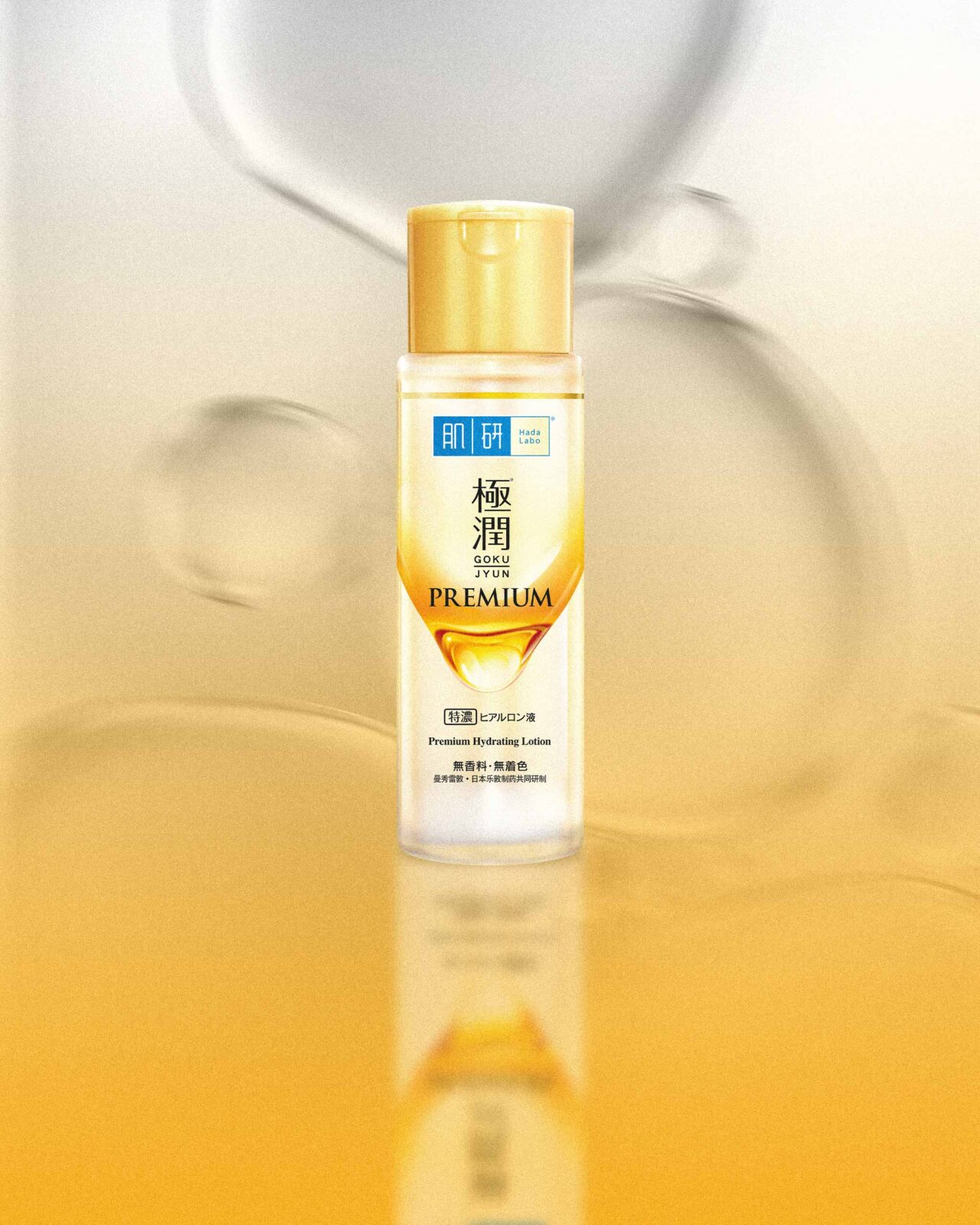
Seen on its gold-colored label, the brand’s intensified formulation features a blend of eight (8) distinct types of hyaluronic acidHyaluronic AcidA powerful humectant that can hold many times its weight in water, giving skin a plump, hydrated, bouncy look. Apply it to slightly damp skin and seal with moisturizer. ItGo to Hyaluronic Acid Glossary, all providing their own amounts of moisture-retaining and skin-plumping effects. But how exactly do each of these types achieve their promised benefits, and how does it differentiate itself from the rest of Hada Labo’s lineup of hyaluronic acid-based serums?
Standard Hyaluronic Acid (Sodium Hyaluronate)
As the largest in molecular weight, Tai details how standard hyaluronic acidHyaluronic AcidA powerful humectant that can hold many times its weight in water, giving skin a plump, hydrated, bouncy look. Apply it to slightly damp skin and seal with moisturizer. ItGo to Hyaluronic Acid Glossary resides on the skin’s outermost surface to form a macroscopic, moisture-retaining veil. Specifically on the outer stratum of the skin, it holds up to 1,000 times its weight in water to create a breathable barrier that prevents immediate evaporation and blocks dry air from stealing the skin’s moisture.
Super Hyaluronic Acid (Sodium Acetylated Hyaluronate)
Super Hyaluronic AcidHyaluronic AcidA powerful humectant that can hold many times its weight in water, giving skin a plump, hydrated, bouncy look. Apply it to slightly damp skin and seal with moisturizer. ItGo to Hyaluronic Acid Glossary is a chemically modified variation of the former, and is made with a blend of acetyl groups, which have a high affinity to non-water-soluble skin molecules to soothe the skin and reduce the usual sticky sensation of typical HA-based serums. “Unlike regular HA that’s easily wiped away, it anchors tightly to skin cells to offer prolonged surface hydration and twice the moisture-holding capacity of regular HA,” Tai explains.
3D Hyaluronic Acid (Sodium Hyaluronate Crosspolymer)
Described as its own water reservoir for prolonged skin hydration, 3D hyaluronic acidHyaluronic AcidA powerful humectant that can hold many times its weight in water, giving skin a plump, hydrated, bouncy look. Apply it to slightly damp skin and seal with moisturizer. ItGo to Hyaluronic Acid Glossary is an interlinked web that binds moisture on the skin’s surface, creating an invisible layer of protection while enhancing the skin’s elasticity and firmness. This particular type of HA is also seen across many, if not most, skin care products, from serums and eye creams to sunscreen and even makeup primers.
Skin-Absorbing Hyaluronic Acid (Hydroxypropyltrimonium Hyaluronate)
While every other variation of hyaluronic acidHyaluronic AcidA powerful humectant that can hold many times its weight in water, giving skin a plump, hydrated, bouncy look. Apply it to slightly damp skin and seal with moisturizer. ItGo to Hyaluronic Acid Glossary also works to make its way across each layer of the skin, skin-absorbing HA uses the principles of electricity to its advantage. Featuring a positive electrical charge that magnetically bonds to the skin’s naturally negative charge, Tai elaborates how these molecules bind so tightly that they won’t easily rinse off, ensuring hydration remains even after sweating or washing your face.
Collage: Sarah El-Ali. Source Image: Courtesy of Hada Labo
Nano Hyaluronic Acid (Hydrolyzed Sodium Hyaluronate)
Made to work alongside its larger molecularly weighted types, nano hyaluronic acidHyaluronic AcidA powerful humectant that can hold many times its weight in water, giving skin a plump, hydrated, bouncy look. Apply it to slightly damp skin and seal with moisturizer. ItGo to Hyaluronic Acid Glossary uses its microscopic size to easily slip past the surface barrier and drench the tightly packed spaces in the skin with deep moisture, instantly plumping up deflated cells for a lasting, refreshed look. This variation is also a key component in the Gokujyun hydrating line, alongside its previously mentioned counterparts.
Penetrating Hyaluronic Acid (Hydrolyzed Hyaluronic Acid)
Tai shares how penetrating hyaluronic acid works as a low-molecular-weight HA made specifically to seep deeper into the skin. “It targets the deeper recesses of the epidermal layer, stimulating hydration pathways to ensure the fundamental base of the skin barrier is completely saturated and plumping from within.”
Fermented Hyaluronic Acid (Lactic Acid Bacteria/Hyaluronate Ferment Filtrate)
While initially part of the Gokujyun’s five-type HA formulation, fermented hyaluronic acid is actually an in-house innovation of Hada Labo’s. Made through a bio-fermentation process that uses bacteria found in the Lactococcus genus to “actively fill in intercellular gaps, strengthen the skin barrier, reduce inflammation, and enhance the skin’s natural moisture retention,” Tai adds.
Repair Hyaluronic Acid (C12-13 Alkyl Glyceryl Hydrolyzed Hyaluronate)
Using penetrating HA as its base, repair hyaluronic acid is a lipid-modified variation that specifically targets damaged areas of the skin barrier. Tai further details, “It binds to broken-down zones to repair rough patches, reinforce lipid membranes, and lock in moisture even in humid climates.
For Hada Labo, Tai explains that each of these HA types results from the brand’s enduring yet evolving use of the body’s naturally produced molecule. And with each innovation that the brand develops alongside hyaluronic acid, Tai shares how these have shifted the brand’s relationship with its signature ingredient. “We no longer see HA as just a humectant, but as an advanced delivery system for deep, holistic skin health,” she adds.
Launched as a two-step routine, the duo’s Premium Hydration lotion may look similar to its more well-known predecessor at first glance, yet Tai details how the two lines were designed to work alongside the natural changes of one’s skin. While the original Gokujyun line focuses on maintaining a balanced moisture barrier, the recently released line features an “intensive, essence-like upgrade for very dry, dehydrated, or fatigued skin.”
Using a formulation of collagen, peptides, and SymWhite® 377 – a pine tree-derived antioxidant designed to bring out the skin’s inner brightness – the lotion features a distinctive 8-type hyaluronic acid blend that operates on a “Layered Hydration System,” utilizing different molecular sizes and properties to maintain moisture within each layer of the epidermis.
The Premium Hydration Cream, however, swaps out Repair Hyaluronic Acid’s skin-surface hydration and barrier-strengthening properties for an added focus on brightening and protecting the skin from external aggressors. Tai also notes that while the line’s eight-layered blend provides an intensified approach to moisturizing the skin, it’s not the direct answer to conditions of chronic dehydration. “[It] rarely occurs in a vacuum, as it is almost always accompanied by a compromised skin architecture, which manifests as structural sagging, deep dehydration lines, and cellular dullness.”
This is where the brand’s blend of hydrolyzed collagen and active peptides steps in. “By reinforcing the skin’s inner support beams while simultaneously saturating it with water, the formula plumps up fine lines from the inside out,” she describes. These two ingredients are then combined with SymWhite® 377, an antioxidant used to prevent the production of excessive melanin in the skin for a brighter, more elastic, and supple finish.
And when paired together, the Premium Hydration duo then serves as a simple yet versatile addition for those looking to stay hydrated through the humid Philippine weather. “Our relationship with hyaluronic acid has evolved from simple topical moisturization to creating innovations in molecular science. Today, we no longer see HA as just a humectant, but as an advanced delivery system for deep, holistic skin health,” Tai shares.
Visit the Hada Labo website to learn more about the Premium Hydration Line. Visit @hadalaboph on Facebook, Instagram, and TikTok to learn more.
Frequently Asked Questions
Standard hyaluronic acid (sodium hyaluronate) is a large-molecule HA that sits on the skin’s surface, forming a moisture-retaining barrier that holds up to 1,000 times its weight in water. Nano hyaluronic acid (hydrolyzed sodium hyaluronate) is a much smaller molecule designed to slip past the surface barrier and deliver deep hydration directly to the skin’s inner layers, plumping deflated cells from within.
Fermented hyaluronic acid (Lactic Acid Bacteria/Hyaluronate Ferment Filtrate) is produced through a bio-fermentation process using bacteria from the Lactococcus genus — making it an in-house Hada Labo innovation rather than a standard cosmetic ingredient. Beyond hydration, it actively fills intercellular gaps, strengthens the skin barrier, reduces inflammation, and enhances the skin’s natural moisture retention capacity.
Skin-absorbing hyaluronic acid (hydroxypropyltrimonium hyaluronate) carries a positive electrical charge that bonds magnetically to the skin’s naturally negative charge. This electrochemical attraction anchors the molecules tightly to skin cells, preventing them from rinsing off easily — meaning hydration is maintained even after sweating or face washing, unlike conventional HA types.
The Premium Hydration Line was formulated specifically for very dry, dehydrated, or fatigued skin, and its Layered Hydration System is designed to maintain moisture within each layer of the epidermis without heaviness. Hada Labo’s regional export manager notes that the line’s repair and barrier-strengthening HA types are particularly relevant in humid Philippine weather, where compromised skin barriers are common despite ambient moisture.
SymWhite® 377 is a pine tree-derived antioxidant included in the Premium Hydration Cream to inhibit excessive melanin production — supporting a brighter, more even skin tone alongside the formula’s hydration and barrier-repair benefits. It works in combination with hydrolyzed collagen and active peptides to address structural sagging, deep dehydration lines, and cellular dullness beyond what hydration alone can correct.