


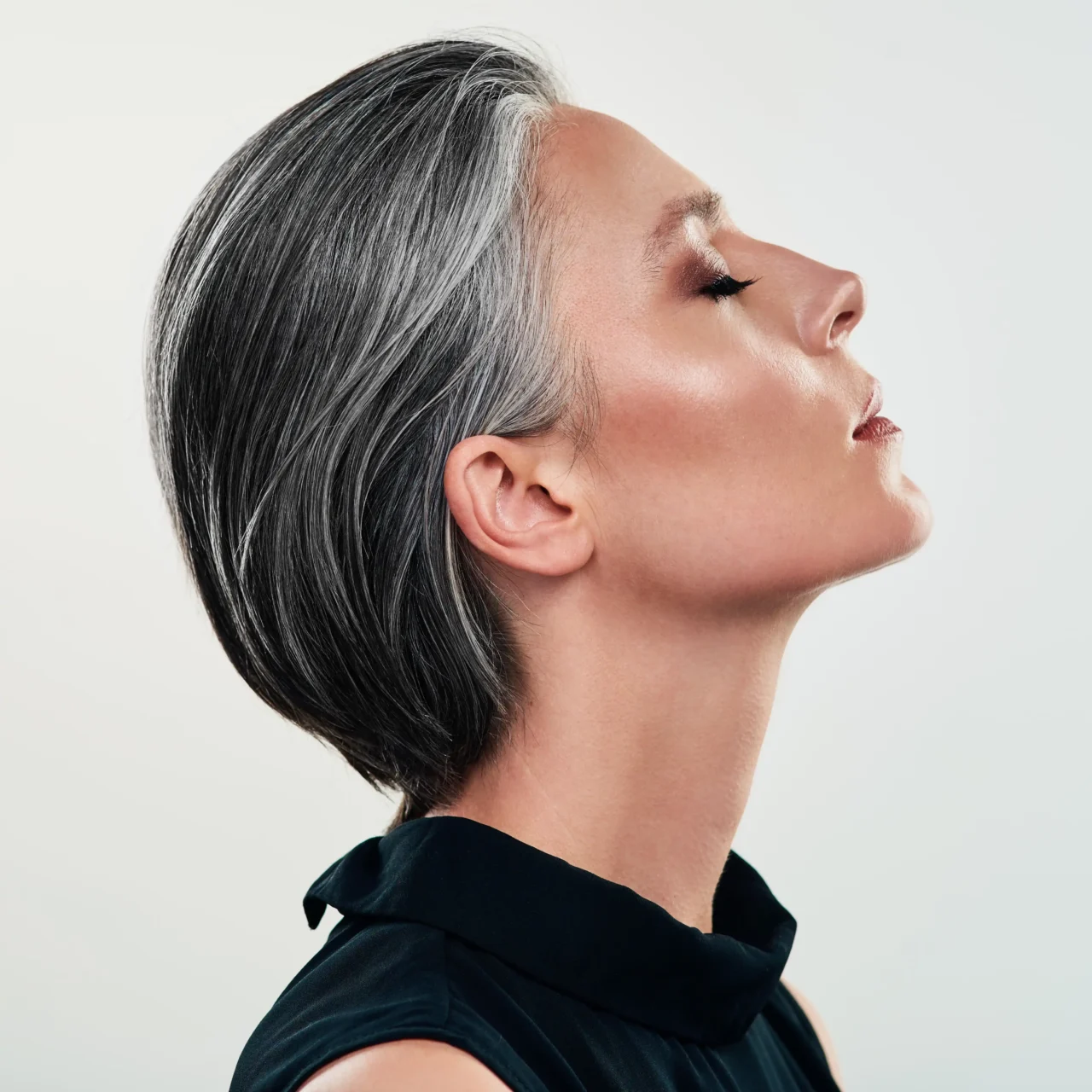
We’ve been conditioned to feel a certain urgency when we notice our first few grays. Commercials for at-home hair color, going back decades, would have you believe that the only course of action after a few silver strands show up is cover, cover, cover. (Never yoink, though—old wives’ tales would have you believe that plucking one gray hair will trigger more to grow in.) The “quiet silver” trend, also known as gray blending, rebuffs the notion that grays must be hidden, allowing for the previously frowned-upon blend of gray and color to shine.
The concept of easing into your gray era isn’t exactly new. Colorist Farah Hurdle does it at her San Diego salon. But as with many trends, it’s been rebranded—this time by Annabelle Taurua of Fresha, a booking platform, who coined “quiet silver” while speaking to Glamour US. But the question remains: Why is the conversation about being okay with your grays coming up yet again?
How to achieve quiet silver hair
The process of going gray gracefully is extremely personal. After all, everyone arrives at the salon with a different base color, varying degrees of gray, and unique goals. It starts, though, with a professional consultation.
Hurdle, who calls her approach to quiet silver “grayblending,” previously told Allure US it’s all about distraction. “Initially, we’re trying to highlight the areas where they have more silver, and then on the areas where they might be darker, we’re lowlighting,” she said, explaining that she uses toners and demi-permanent color to add dimension around the gray.
L’Oréal Professionnel is launching a hair-color application method to achieve this. Called “French blending,” it’s “designed to match every level of gray acceptance,” says Jacob Habib Khan, a stylist and global creative contributor for the brand. “We formulate the shade that’s right for you using one of three different coloring techniques—first blending, retouch blending, and total blending—to not only cover gray hair, but also blend them for a more natural look and seamless grow-out.”
First blending involves creating contrast with the first patches of gray for a natural, camouflaged look. This restrained approach ensures softer regrowth between salon appointments. With retouch blending, the goal is to move away from the “helmet effect” line of demarcation that comes with gray coverage, softening the banding. Total blending fully embraces grays for a more visible transformation.
French blending, overall, is based on a highly personalized strategy. “For some clients, it could take a micro-teasing approach—which involves gently back-combing tiny, thin sections of hair before applying lightener—and others could be candidates for a balayage,” Khan says. “It’s all about mirroring and re-creating the gray pattern to give the best possible blend for each client.”
If you think starting with lighter hair might make for an easier path to quiet silver, you’re not wrong. “I do think it’s a bit more of a seamless look on someone with a lighter natural hair color,” says Victoria Suarez, a colorist at Anushka Spa & Salon in Palm Beach. “The blend is much better since the two colors do not have such a stark contrast.” But that doesn’t mean it’s out of the question for those with dark hair. Says Khan, “absolutely any hair color” can look gorgeous with gray mixed in.
Envato Images
How to achieve quiet silver hair at home
It probably comes as no surprise that the colorists we spoke to are all but dead set against attempting to achieve quiet silver at home, not just because they’re not getting you as a client but because it’s really something best left to the pros. That being said, Chloe Williams, a hairstylistHairstylistA beauty professional who specializes in cutting, coloring, styling, and caring for hair, combining technical expertise and creativity to enhance individual style, confidence, and self-expression.Go to Hairstylist Glossary and co-owner of He+Loe Studio in Delray Beach, Florida, reluctantly shared her recommendation if you’re determined to do it on your own.
“You could use a demi-permanent color that wouldn’t cover 100 percent of your grays,” she tells Allure. “This would just add a bit of a tint to the hair without the opaque gray coverage of your typical single process.”
Shvonne Perkins, master colorist and education director at Madison Reed, concurs. “I call it ‘gray camouflage’ because some hairs will be almost totally covered and some will be tinted, shaded, or camouflaged, resulting in an effect that is more dimensional and multi-tonal,” she says.
How to maintain quiet silver hair
It might take a while for you to decide to move forward with fully embracing your gray. Staying in this quiet silver phase is completely okay.
To maintain it, Suarez says, it’s key to consider your base color and how much warmth you’re willing to tolerate. For lighter colors, she recommends using a purple shampoo once a week to keep your tones from getting too brassy.
For darker hair, Suarez says, use a color-safe shampoo that won’t strip away the richness of your deeper tones.
Regardless of your shade, color-treated hair can always benefit from the occasional mask to address the dryness that often comes with coloring.
Glosses may seem like a smart idea, but the results are unpredictable with color-depositing versions, Williams says. However, a clear gloss undoes dullness to keep your color its shiniest.
Originally published in Allure US.
Frequently Asked Questions
Quiet silver, also called gray blending, is a hair color approach that works with emerging gray strands rather than covering them entirely. Unlike full gray coverage, it uses highlights, lowlights, toners, and demi-permanent color to create a dimensional, multi-tonal result that integrates gray naturally — allowing for a gradual, seamless transition rather than a sudden shift.
French blending is a personalized hair color method developed by L’Oréal Professionnel that uses one of three techniques — first blending for early grays, retouch blending to soften the line of demarcation, and total blending for full gray embrace — to integrate gray naturally into existing hair color. The approach may include micro-teasing or balayage depending on the client’s gray pattern and goals.
Quiet silver works on all hair colors, though the blending process differs. On lighter bases, the transition is more seamless due to less contrast between gray and existing color. On darker hair, colorists use targeted highlighting and toning techniques to mirror the natural gray pattern and reduce stark demarcation — the result is more dimensional rather than uniform.
Colorists recommend demi-permanent color as the most viable at-home option for gray blending. Unlike permanent color, demi-permanent does not provide full gray coverage — it tints some strands while leaving others semi-transparent, creating a dimensional, multi-tonal effect rather than flat, opaque coverage. Full quiet silver results are best achieved with a professional colorist consultation.
Maintenance depends on your base color. For lighter tones, a purple shampoo used once weekly prevents brassiness. For darker hair, a color-safe shampoo preserves depth without stripping richness. Both benefit from an occasional deep conditioning mask to address color-related dryness. Clear gloss treatments add shine without the unpredictable results of color-depositing versions.