
What Running Taught Charmaine Palermo About Life, Beauty, and Showing Up
The Posh Skin co-founder shares life lessons on running, recovery, and why consistency matters more than perfection.
By Nina Cortez


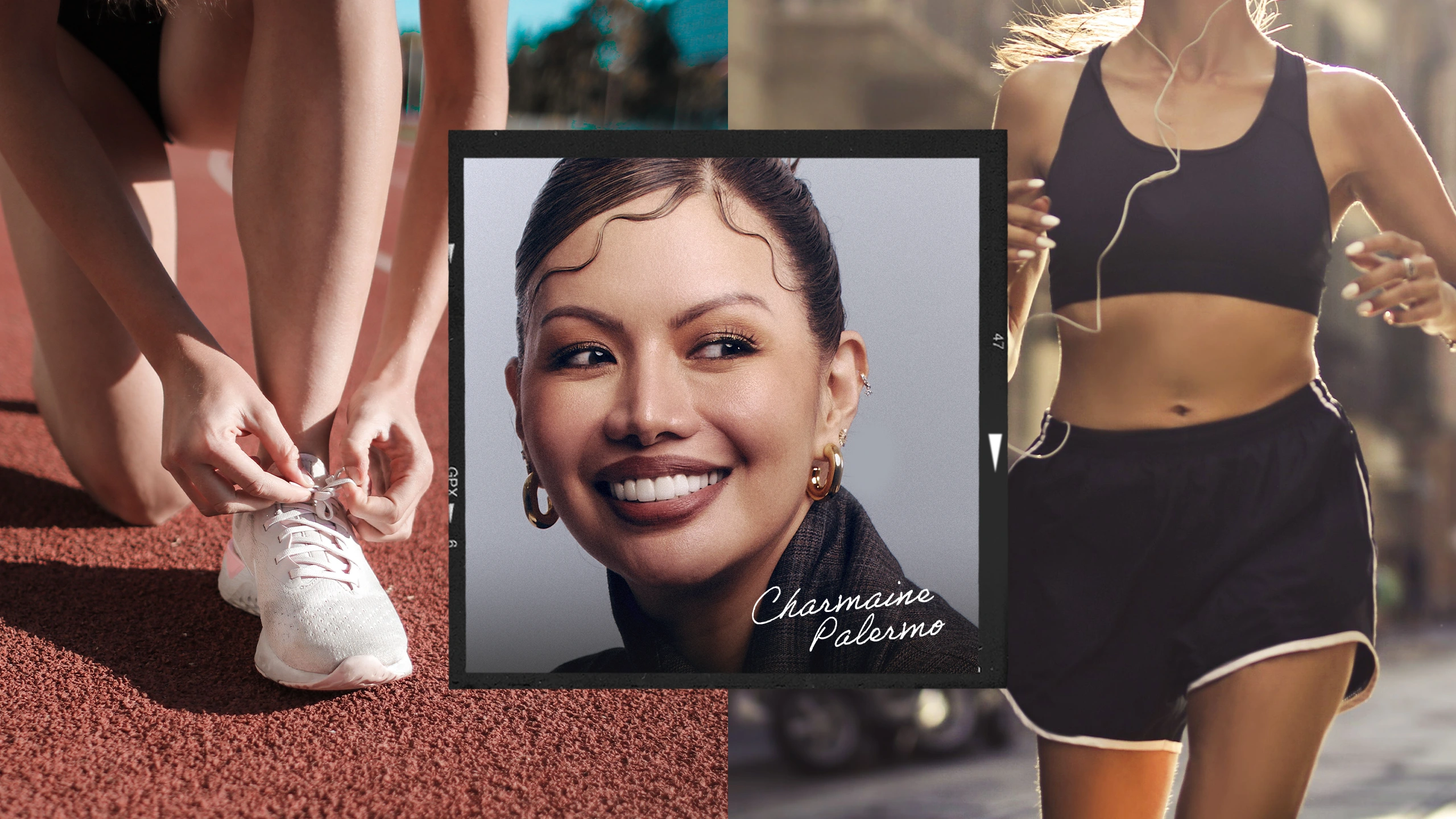
On October 13, 2024, at 7:20 a.m., a cool autumn morning settled over Chicago, Illinois. It’s an entire world and some 8,131 miles away from Manila, and Posh Skin co-founder Charmaine Palermo is among the thousands taking to the streets for the annual Chicago Marathon, with another personal best to put under her belt.
It’s a 42-kilometer run for Palermo, and as she shares, her third major marathon since she started her running journey about a decade ago. Months of exercise—punctuated by yoga and other forms of resistance training—led her to that exact moment of courage, with nothing but the open road between her and the finish line.
Those familiar with her would recognize her through the playfully designed pimple patches that put Posh Skin on the beauty map. They would also know Chármá, her activewear brand, her PR agency, or her years-long work as a model and stylist. Palermo is a busy woman who moves with ease between creative pursuits and the demands of building a skin-forward brand—it’s her passion, after all—and anyone who knows her would recognize that movement and wellness remain atop her priorities, no matter how full her schedule gets.
“You just put on your running shoes and you go outside and you can run,” she says in an exclusive interview with Allure Philippines. “The more I do it, the more I fall in love with it, because it just gives me time for myself.”
But in June 2024, four gruelling months before the Chicago Marathon, an unexpected ankle injury threatened to undo months and months of preparation.
“I went through a rollercoaster of emotions,” she wrote on Instagram. “I was in denial and I kept trying to run, but that only worsened my situation. I thought I wouldn’t be able to run [the] Chicago Marathon […] until I finally accepted that I need to prioritise my recovery from the injury and let go of my PB goals for now.”
Today, she looks back at that time with fondness. The Chicago Marathon remains one of the most defining moments of her running journey because of what it took to finish. Still recovering from an injured ankle and cramps by the 28-kilometer mark, she had to reckon with the possibility of not making it to the end. She walked when she needed to, stopped at aid stations for help, and still kept going.
At five hours and 20 minutes, the Chicago Marathon was one of her slowest marathons, but the finish line allowed her to discover a different measure of achievement: patience, knowing her limits, and the pride of knowing she had made it through despite. In this exclusive interview with Allure Philippines, the Posh Skin co-founder gets candid about her running journey, why it evolved into her classroom of life, and how she personally cares for her skin afterwards.
What drew you to running?
Mostly, in the beginning, it was for physical fitness. I started in 2015. So, that was like a decade ago. Running was to add to my resistance training and yoga, so my coach told me I have to do some form of cardio. I thought that running was the easiest, because you just put on your running shoes and you go outside and you can run. But moving—the more I do it, the more I fell in love with it! It just gives me so much time for myself.
When I’m running, it’s my me-time. So, I’m more present at the moment and it gives me clarity. It challenges me also, because I have all these goals to achieve with races or with my pace, my time, and it taught me a lot of values. So, running is actually kind of my classroom in life—every run teaches me something.
What does running do for your mind that other forms of exercise don’t?
Out of all the exercises that I do, this one does not only make me grow physically but also mentally. In the beginning, running was supporting my strength workouts, but now, everything else supports my running now. So my strength training is geared towards making me a stronger runner.
Do you remember a moment during a run when you realized, “I’m stronger than I thought I was”?
A lot of moments, actually. But what stands out to me right now is the Chicago Marathon. I did that in 2024. And I was injured. I was recovering from an injury. So, I was injured during the training block, and I just couldn’t! On the 28-kilometer mark, I was cramping all over, and I thought that I couldn’t finish it anymore. But I told myself, no, you flew all the way here.
If you need to walk, you walk. You just have to finish it. But I would stop in all the aid stations, and the physical therapist there, the medics, would, like, spray some menthol thing on my leg just to help me keep going. And I actually finished it. And I’m super proud of myself with that. Chicago was one of my slowest at 5:20.
What was your fastest run?
I thought that the Sydney Marathon last year was my strongest moment, because I got a personal best.
My watch died on the 22-kilometer mark—so, I ran 20 kilometers with no watch! I was just running by feel. I was trying to remember how I felt when I’m running on the track—when I’m doing speed intervals, when I’m doing long runs. And I was just praying.
It was my faith that brought me to the finish line, and when I looked at my phone afterwards to look at my time in the app, I finished in 4:18. I was so amazed!
What’s one thing you wish you knew about taking care of yourself as a runner when you first started?
Recovery is as important as training. Sleep is the best recovery tool ever. I learned that recently—maybe the past two years, but it’s so important to get good quality sleep and not to sacrifice sleep with performance.
What’s the earliest time you woke up to train for running?
12 midnight. Like, two weeks ago. For the run for the Trilogy Asia, I slept at 7 p.m. and I woke up at 12 midnight because the race was at 2 a.m. So, if you sleep at 7, you have to have dinner at 4 p.m. If you sleep and if you haven’t digested the food, your quality of sleep is really bad, so it has to be, like, three hours before bedtime.
It’s also learning—all the years that I’ve been running, I just kept learning, like, what’s good for me, what’s not good, and I just try and improve all the time.
What does your post-run recovery and wellness routine look like?
Right after a run, I make sure I hydrate, and I eat carbs and protein to repair my muscles for the protein. But carbs are really, really important. And then I stretch. I make sure I shower to clean off all the sweat and the dust, and then what else do I do after running? So, I eat, I stretch, I clean myself, and then at night, I will do my recovery boots—like compression boots for better blood flow recovery.
How has running changed you?
A lot. Like, running, I told you guys, running has taught me so much. It really taught me to be patient. It taught me how to be consistent and to show up, even if it’s challenging, and that’s the same with my everyday life.
If I encounter challenges at work or relationships or even, like, the government disappoints you, you just have to keep showing up. And, you know, it gives you hope that it will all work out because a lot of runs, you feel like you’re not strong enough—you can’t finish, it’s hard, this hurts, or whatever, but if you just keep pushing—not push to injury, but you know your limits. It taught me to focus on things I can control and to let go of things I cannot control.
As someone who works in beauty, how has being active changed the way you think about skin care?
Okay, so, working in the skin care industry and being active is actually, it kind of complements each other for me because I, how do I say? I think that it gave me a different perspective when it comes to perfection. Like, being in fitness, you don’t have to be perfect all the time.
And the same thing [can be said] with skin care. You don’t have to look perfect, there’s no perfect! But as long as you consistently show up, you consistently do your skin care routine, even if it’s just three steps, the results will come—and I think that running and being active has taught me that.
What have you learned about caring for your skin when you’re exercising regularly?
You need to put on a sunblock. Make sure you have sunblock, especially if you’re outdoors. And to reapply every 90 minutes because the sweat will just take it out from your face.
Second, wash your face, to really clean your face after you exercise outdoors so that the sweat will come off, the dirt and all the environmental factors can be removed. If you have a zit, you make sure to cover it so that it will be protected from dust and pollution.
What do you usually do with your skin after a really sweaty run?
I wash it off. I really wash my face after, right after a run, no matter how long or how short it is, I go home and I wash my face. My facial wash is Posh Skin—it’s an anti-acne facial wash that I use, and it’s designed for humid weather. And after that, I put on my tonerTonerA liquid step used after cleansing to rebalance, hydrate, or prep skin for the products that follow. Modern toners often focus on hydration or gentle exfoliation rather than stripping alcohol,Go to Toner Glossary and my moisturizer. That’s it!
Frequently Asked Questions
Palermo started running in 2015 after her coach advised adding cardio to her resistance training and yoga. She found it the simplest option, needing only running shoes. It became her personal time for clarity and challenge, and she now treats every run as a lesson.
At the 2024 Chicago Marathon, Palermo was still recovering from an ankle injury and cramping by the 28-kilometer mark. She walked when needed, took help from medics at aid stations, and finished in 5:20, one of her slowest marathons but one she is proud of.
After a run, Palermo hydrates and eats carbohydrates and protein to repair muscles, then stretches, showers, and eats. At night she uses compression boots to support blood flow recovery. She also stresses sleep, calling it the best recovery tool she has learned about.
Palermo recommends reapplying sunblock every 90 minutes when exercising outdoors, because sweat removes it from the face. She also advises washing your face after outdoor workouts to remove sweat, dirt, and environmental factors, and covering any pimple to protect it from dust and pollution.
Palermo washes her face right after every run, however long, using Posh Skin’s anti-acne facial wash, which is designed for humid weather. She then applies toner and moisturizer. She says consistency matters more than perfection, even if a routine is only three steps.
Nina Cortez
Nina Cortez is a Digital Content Writer at Allure Philippines. With a background in editorial writing and cultural commentary, she specializes in digital culture and online communities, exploring how they influence beauty trends and consumer behavior. Her academic research on the credibility of beauty reviews on social media further informs her understanding of how products and trends are discussed, discovered, and consumed online. At Allure Philippines, she covers beauty and culture through a digital-first lens, examining the trends and conversations shaping the industry.
Latest Stories


You might also like


To provide a customized ad experience, we need to know if you are of legal age in your region.
By making a selection, you agree to our Terms & Conditions.