From L’Oréal to Dieux Skin: How Joyce de Lemos Is Revolutionizing Skin Care with Science
A Filipina biochemist and cosmetic scientist, Joyce de Lemos traded billion-dollar beauty giants for an indie brand rooted in science, integrity, and groundbreaking formulations.



Joyce de Lemos is the highly-trained boffin behind Dieux Skin, a New York-based indie skin care brand that started in 2018. She describes herself as a “mad scientist” and “cosmetic cook,” but behind the casual labels, she’s established by years of education and training—from a Master’s degree in cosmetic science to experience in global beauty giants like L’Oréal and Cosmax. This, ironically, makes her one of the rare product developers with legitimate scientific expertise, setting the standard in an industry where many hold the title without the credentials. There may be many ways to approach product development, but for de Lemos, it’s about creating groundbreaking formulations that push the industry forward.
In the first Allure Philippines’ Meet the Expert series, we explore what truly defines a cosmetic product developer with de Lemos. She shares her journey, the science behind her formulations, and her vision for the future of skin care.
Can you walk us through your background in biochemistry and cosmetic science?
I loved science from a young age and I received my Bachelor’s degree in biochemistry from Cal Poly San Luis Obispo, a university in California known for its STEM programs. I worked for a company called Gilead, which is known for revolutionizing HIV therapy and also making REM or remdesivir, the injectable for COVID-19. At 21 or 22, I was making big money, taking my parents to fancy restaurants, doing all that stuff. After five years, I came home thinking, this sucks. This is so boring, I’m not curious, I don’t want to do this anymore. It was the rise of the internet, so I Googled what I could do with a biochemistry degree. That’s how I found cosmetic science. I emailed one of the professors through my AOL account, and then I went to New York, visited the campus, and told myself to just do it. I was going to take the risk. In 2010, I moved across the country to pursue my Master’s in cosmetic science. Here is where I learned about something called “colloid chemistry.” Essentially, it’s the chemistry of how to mix different substances that are normally immiscible (or not combinable into one phase) and stabilize them among each other.
How did this formal education shape your approach to product development, and how do you apply your scientific knowledge when creating formulations?
I’ll explain using the chemistry of mayonnaise. The main ingredients are oil, vinegar, and egg yolk—it acts as a binder or what we call an emulsifier. This stabilizes the mixture, making two formerly immiscible ingredients mixable!
That’s an example of one type of chemical knowledge that I apply when formulating products. But instead of oil and vinegar, we’re working with humectants, water-binding ingredients, preservatives, oil-based emollients, and butters with complex structures. My understanding of how these ingredients interact with each other is what has enabled me to create formulas that are stable and also elegant in texture.
This is one part of the equation. The other part of the equation is an understanding in skin physiology. What’s skin made of? During my Master’s, I studied skin composition and physiology. In order to understand how to create products that will benefit the skin, it’s helpful to know what skin is made of, what its life cycle is, and what causes wrinkles, hyperpigmentation, scars.
Where did you hone your cosmetic acumen? How did you get started in the industry?
I first worked at L’Oréal as a contract employee. When you work as a contractor for a French company, they keep you as a contractor. On my last day, I wrote them like a bleeding-heart letter that [said], ‘Hey, I moved here from California. I’m really interested in the company. I’ve learned so much. I see there’s a position open. Would you consider me for an interview?’ That’s how I got hired. From an education perspective, more programs are available. Fifteen years ago, there were only three programs in the United States. I chose the one next to the coolest city, which is New York.
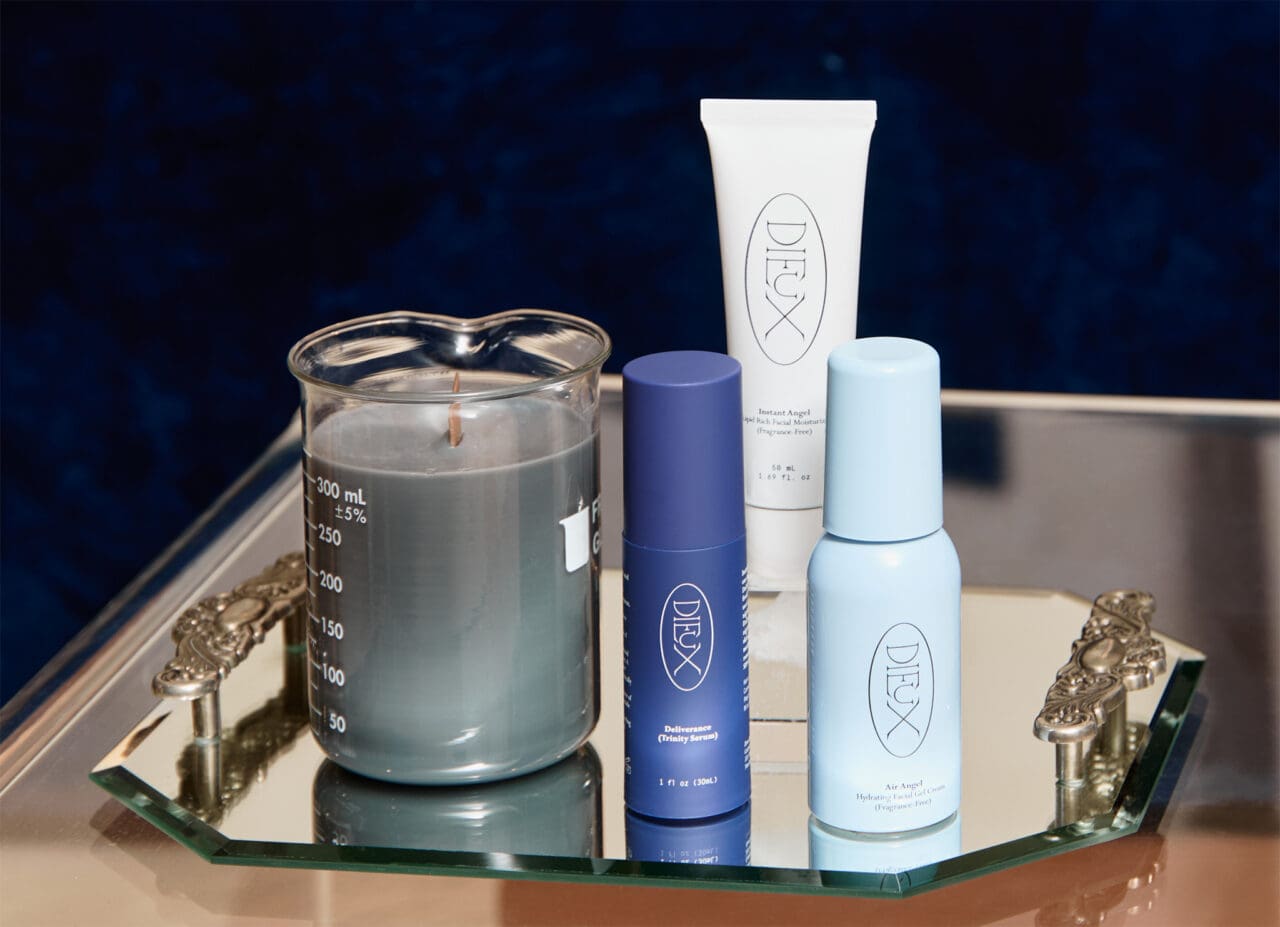
Dieux Skin Products. Courtesy of Tone Woolfe.
What were the most valuable lessons from working in global beauty corporations like L’Oréal and Cosmax that you apply to your work at Dieux?
At L’Oréal, I learned how to work cross-functionally with so many different teams to launch a product. You get to see the entire process from ideation to formulation to clinical testing, and production. Timelines were a bit longer, so we were given adequate time to get to know our formulations and products. Conversely, at Cosmax, I learned how to move at the speed of light. We were asked to reverse engineer products all the time with two-week turnarounds. If we didn’t present something to a potential client quickly enough, we’d lose the partnership to another contract manufacturer. It was intense, but I also learned how to be a more efficient formulator, creating and testing multiple iterations all at one time, while still focusing on delivering quality formulations within a very short timeframe.
The beauty industry has seen a rise in self-proclaimed skin care experts and “product developers” with no scientific background. How do you think this affects consumer trust and product quality?
I’m sure, like any vocation where there are self-taught experts, there are some great, knowledgeable product developers out there that make quality products. I will say though that without a foundation rooted in chemistry and skin physiology, it would take a self-taught product developer a lot of time, practice, trial, and error to become an expert.
What are some key scientific principles behind effective skin care formulation that often get overlooked by non-scientist “product developers”?
Non-scientist “product developers” might include great skin care active ingredients into their formulations, but not at percentages high enough to be effective. For example, a clinical study might demonstrate that an active ingredient is effective when used in a formula at two percent. But for one reason or another, some product developers will use this ingredient at a percentage much lower than two percent.
In the Philippines, the term “product developer” is often used loosely. Many local “product developers” act more as intermediaries between brands and suppliers, and this is why a lot of local releases end up being similar to each other. How does your expertise differ from those who simply coordinate with suppliers?
What sets my approach apart from those who simply coordinate with suppliers is my understanding of the processes involved and required from both the brand and the contract manufacturer, all through the lens of my cosmetic science background. I understand gaps in the market and the importance of innovation and new technologies. I also know what’s feasible from a scale-up perspective—it might be doable to create one small experimental unit of a formula in a lab, but you might not be able to reproduce 100,000 units of that same formula. All the while, my understanding of cosmetic chemistry allows for me to assess if the formula is being compromised from a chemistry standpoint.

Joyce de Lemos and Charlotte Palermino, co-founders of Dieux Skin. Courtesy of Tone Woolfe.
How did Dieux start?
Char (Charlotte Palermino, Dieux’s co-founder) came up with the idea in 2018. I’d already worked at L’Oreal and Cosmax, which makes all the Korean skin care brands you know. I used my network to pitch formulas to celebrities, influencers, music producers—anybody who wanted to start their own skin care company, which is, surprisingly, a lot. Charlotte was one of them. We met at the top of 2019 and in 2020, once the research and development for one of our flagship products was done, I wanted to sign on. We became co-founders. We also had a third co-founder, Marta Freedman, who focused on design.
Can you break down the process of developing a new skin care product—from concept to final formulation?
When ideating, we ask ourselves: How is this product different and better from anything else that’s already on the market?
We’re constantly combing the globe for innovations in ingredients, formulation textures, packaging, and clinical-testing techniques. From the very beginning of drawing up the concept, it has to have something that sets it apart from the rest. After that, the formulation process begins. When I formulate, it’s very much like building a house. I focus on the main priority—the texture—which is ultimately the foundation and groundwork of the house.
Then I curate the active ingredients that I want to include. I only look for active ingredients that are clinically proven and also cost-effective. We’re always keeping in mind that by keeping the formula cost down, we can pass those savings on to our customers. Once the formula is close to approval, we conduct preliminary quality testing. We also work with external labs to conduct in-vivo clinical testing. We conduct clinical testing of the final formulation so we understand how effective our formulas are once all is said and done. Clinical testing can be costly, but we know it’s worth it when we’ve created something that delivers. It’s what keeps our people coming back and builds trust with our community.
How does this process look like for a specific product you’ve already developed?
I love talking about our award-winning moisturizer Instant Angel Moisturizer. As our skin ages, its composition changes. There is a progressive depletion of essential lipids and natural moisturizing factors in the skin barrier. When the lipid barrier lacks these, skin can lose its elasticity, plumpness, moisturization, which can appear as sagging, fine lines, and wrinkles. When creating Instant Angel, I sought to replenish these, but I wanted to do so with ingredients that were not only functional, bioavailable (meaning compatible with skin), but also cost-effective. Skin care only works if people commit to a routine that works for them, and we didn’t want the price to deter people from doing so. Lastly, I wanted the formula to be elegant in texture. It’s universally-loved and accepted, that’s why I’m so proud of it.
What are the biggest formulation mistakes you’ve seen in the beauty industry due to a lack of scientific expertise?
People become overly-focused on including active ingredients in their formulations that don’t chemically make sense. A great example of this are products that contain acid exfoliants. I’ve seen products claiming to contain alpha hydroxy acids. These acids work to encourage cell turnover by helping to break down the bonds of dead skin cells, so new ones can emerge. In order for this to work, the optimal pH is usually around four or so. But when I take the pH of the product, it’s higher—around six to seven. That means that the acid is somewhat neutralized and not as effective.
Another formulation mistake I see is more about formula protection. I see a lot of products containing expensive active ingredients like stabilized vitamin C derivatives or retinoids being delivered in open-air containers like dropper bottles, clear glass, or jars. But these ingredients can be susceptible to degradation when exposed to oxygen and light. A product that originally had two percent of a vitamin C derivative then actually ends up having less than one percent after degrading.
Many brands rely on third-party manufacturers to formulate products. What do you think is lost when founders or brand teams don’t have a technical background in cosmetic science?
Brands will often be told by a contract manufacturer that their formulation or product idea is feasible and scalable. But the reality is sometimes the contract manufacturers might overpromise before actually validating the formula with these tests. Without knowing what these are or being familiar with them, potential founders can be easy for details to fall in the cracks and manufacturing issues to occur in the future.
What’s a skin care myth you wish more people understood from a scientific perspective?
That skin care works overnight! It takes dedication and a routine. If you see a product saying that it will reduce wrinkles or change your skin composition in 30 seconds or overnight, that’s not possible. Skin cells have a natural life cycle. It usually takes at least 28 days for old skin cells to die and for new ones to replace them. Age slows down this turnover. This emergence of new skin cells is the time when you see the benefits and changes that can occur with your skin. Chemical peels, lasers, and retinoids can all help encourage this skin turnover process, revealing new skin, but your skin still needs adequate time to shed old skin cells and grow new ones for you to see and reap these benefits.
How do you envision the future of skin care evolving in the next decade?
Consumers are becoming more aware and more educated. They’re searching for information. Brands are acquiescing to that demand and meeting it. What I’ve seen trending also is more inclusion across the board. There will be more products to meet different types of beauty. You go on the internet and you see plus-sized models and people with darker skin tones. You see Bretman Rock and, like, stunning, you know? And it just gives me hope for the future of beauty, that it’s going to evolve, and everybody’s going to feel represented by the products that are available to them.