
Noticing Hair Loss? Here’s What a Dermatologist Says to Do First
From normal shedding to widening parts and thinning hair, a board-certified dermatologist explains how to identify possible causes of hair loss—and when it may be time to seek treatment.
By Nina Cortez


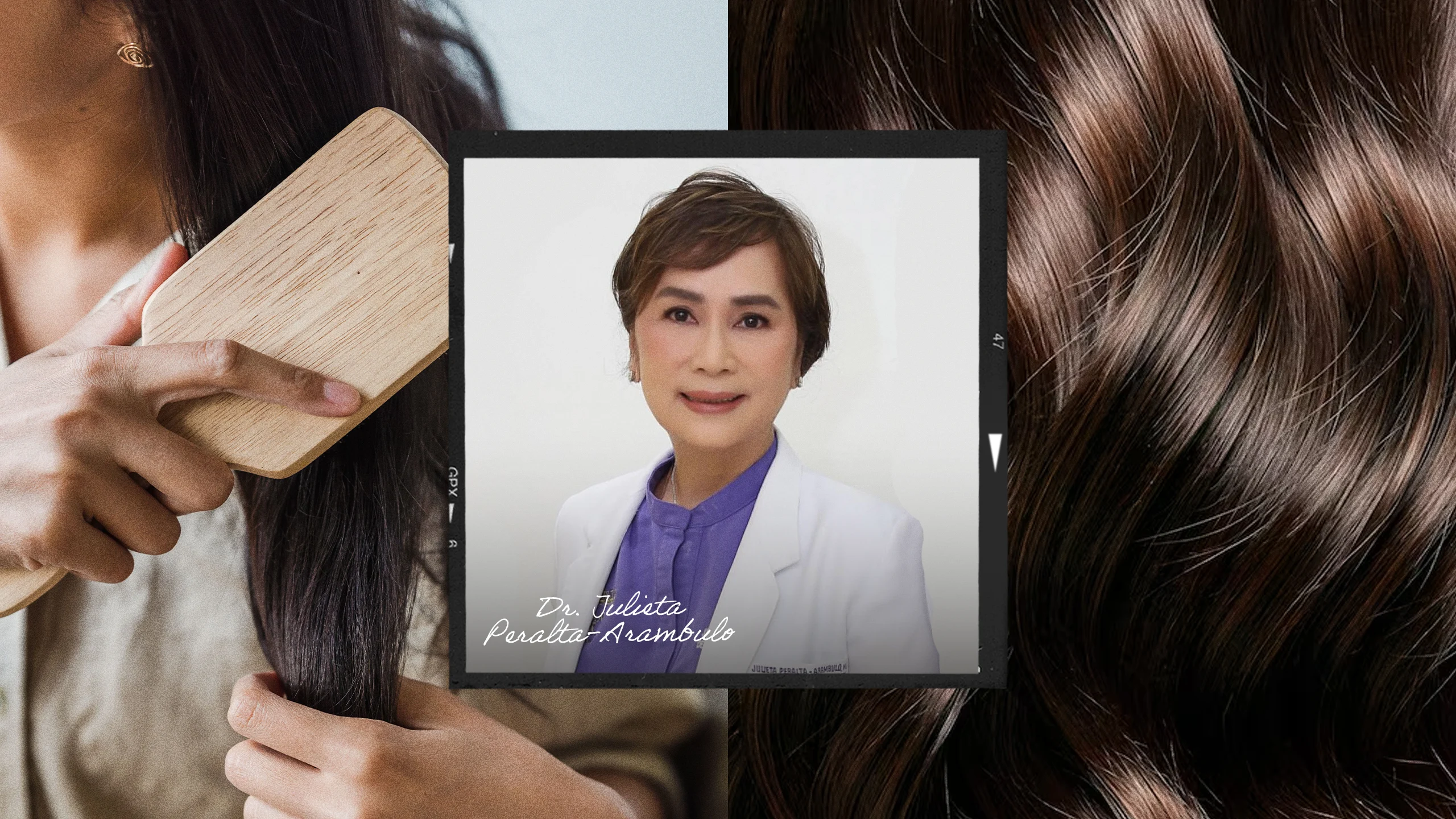
In the age of self-expression, we are conditioned to think about hair entirely in terms of styling. We color it, smoothen it, chop it into a bob, or coax it to grow longer. But that single hagod—a handful of hair left behind in your palm—is enough to instantly break the spell and send a jolt of panic through our otherwise style-forward routine.
Suddenly, the conversation shifts. A part that looks a little wider under the bathroom lights, a hairline that feels slightly receded, or a patch of scalp that was never noticeable before can make you question everything happening from within. With an endless market of serums, scalp scrubs, and quick-fix formulas promising thicker, fuller hair, the temptation to treat the symptom before you even understand the cause is hard to resist.
In this exclusive Allure Philippines interview, board-certified dermatologist Julieta Peralta Arambulo, MD, explains why the first step when dealing with hair loss isn’t necessarily finding a treatment, but understanding what’s actually causing the change.
Know what’s normal
Losing some hair every day is part of the hair cycle. “Usually, about 100 to 150 strands,” Arambulo notes when asked how much shedding falls within the normal range. But when the amount or pattern of hair loss starts to change, a closer look from an expert may be necessary.
Look beyond the hair
Before treating hair loss, Arambulo says it’s important to first understand what’s causing it. In her practice, that starts with the patient’s history. “The first thing [we do] is require you to fill out a form for us to understand your medical history,” she says. It gives her a clearer picture of the patient’s condition before she examines the scalp.
She then uses AI-driven trichoscopy to help assess the diagnosis. “After filling up the form and making the evaluation, we transfer the patient to the next room for examination using the AI-driven trichoscopy to confirm the diagnosis.”
For patients with permanent hair loss, Dr. Arambulo also recommends genetic testing, particularly when native hair is still present and the pattern of hair loss is mild. “It will eliminate the trial-and-error treatment. It will personalize the treatment based on the genetic profile,” she says, and the results can help guide which medications may be most appropriate for the patient.
When does a hair transplant make sense?
A hair transplant isn’t necessarily the first step for someone experiencing hair loss. For Arambulo, the decision starts with establishing the right diagnosis and understanding how much hair has already been lost.
“If the patient is suffering from androgenetic alopecia—usually this is permanent hair loss—and it also depends on the pattern of hair loss,” she explains. When the pattern begins to show bald areas and terminal hairs have already been lost, “then that’s the time I would recommend hair transplantation.”
Even then, there may be native hair worth preserving before moving on to the procedure. “With the remaining native hair, I would recommend maintaining it with regenerative programs or some prescription treatments for their hair to grow thicker.”
Where else can donor hair come from?
When it does come time for a transplant, the hair doesn’t necessarily have to come from the usual donor area on the scalp. For patients whose donor supply has been depleted, including those who have had a previous transplant, Arambulo says hair from other parts of the body can also be considered. “There are other sources of hair that can be used,” she says, including hair from the arms, beard, pubic area, legs, chest, and thighs. “I’ve experienced harvesting from those potential donor areas with good success in my patients.”
What about a DHI?
DHI, or Direct Hair Implantation, is often mentioned alongside hair-transplant techniques, but Arambulo makes an important distinction: it describes how grafts are placed, rather than how they are harvested.
“DHI stands for Direct Hair Implantation. It’s not a hair transplant technique; it is a technique to place the grafts into the scalp directly using an implanter pen,” she explains.
Your ponytail could be part of the picture, too.
Sometimes, the culprit is hiding in plain sight. Hair loss isn’t always something happening entirely on its own—how hair is styled can put repeated stress on the follicles.
“We have a condition called traction alopecia,” says the dermatologist. “You’ll be surprised that hair styling—the pulling of hair, if it’s done constantly—can destroy the hair follicles.” She says this can happen when hair is repeatedly pulled into ponytails or other tight hairstyles, particularly among younger patients.
“If it’s too tight, the traction will be there. If it stays there that long, the hair follicles will be destroyed, and it’ll be hard to regrow them again,” Dr. Arambulo concludes.
Hair loss can feel like something you have to fix immediately, especially when the change is visible in the mirror. But as Dr. Arambulo’s approach suggests, knowing when to intervene and knowing when to simply protect the hair you still have can be just as important as choosing a treatment.
Frequently Asked Questions
Losing about 100 to 150 strands daily is normal, says dermatologist Julieta Arambulo. A wider part, receding hairline, or visible scalp patch signals a shift beyond typical shedding and warrants a dermatologist evaluation.
AI-driven trichoscopy is a scalp-imaging technology dermatologists use after reviewing a patient’s medical history. It examines the scalp and follicles closely, helping confirm a diagnosis before recommending treatment.
Dermatologists recommend transplantation once androgenetic alopecia has progressed to visible bald patches and terminal hair loss, not as a first step. Remaining native hair is usually maintained with regenerative programs first.
Yes. For patients with depleted scalp donor supply, including prior transplant patients, dermatologists can harvest grafts from the arms, beard, pubic area, legs, chest, or thighs.
Traction alopecia results from constant pulling on hair follicles, often from tight ponytails, especially in younger patients. If tension continues long enough, follicles are destroyed and become hard to regrow.
Nina Cortez
Nina Cortez is a Digital Content Writer at Allure Philippines. With a background in editorial writing and cultural commentary, she specializes in digital culture and online communities, exploring how they influence beauty trends and consumer behavior. Her academic research on the credibility of beauty reviews on social media further informs her understanding of how products and trends are discussed, discovered, and consumed online. At Allure Philippines, she covers beauty and culture through a digital-first lens, examining the trends and conversations shaping the industry.
Latest Stories


You might also like




To provide a customized ad experience, we need to know if you are of legal age in your region.
By making a selection, you agree to our Terms & Conditions.