

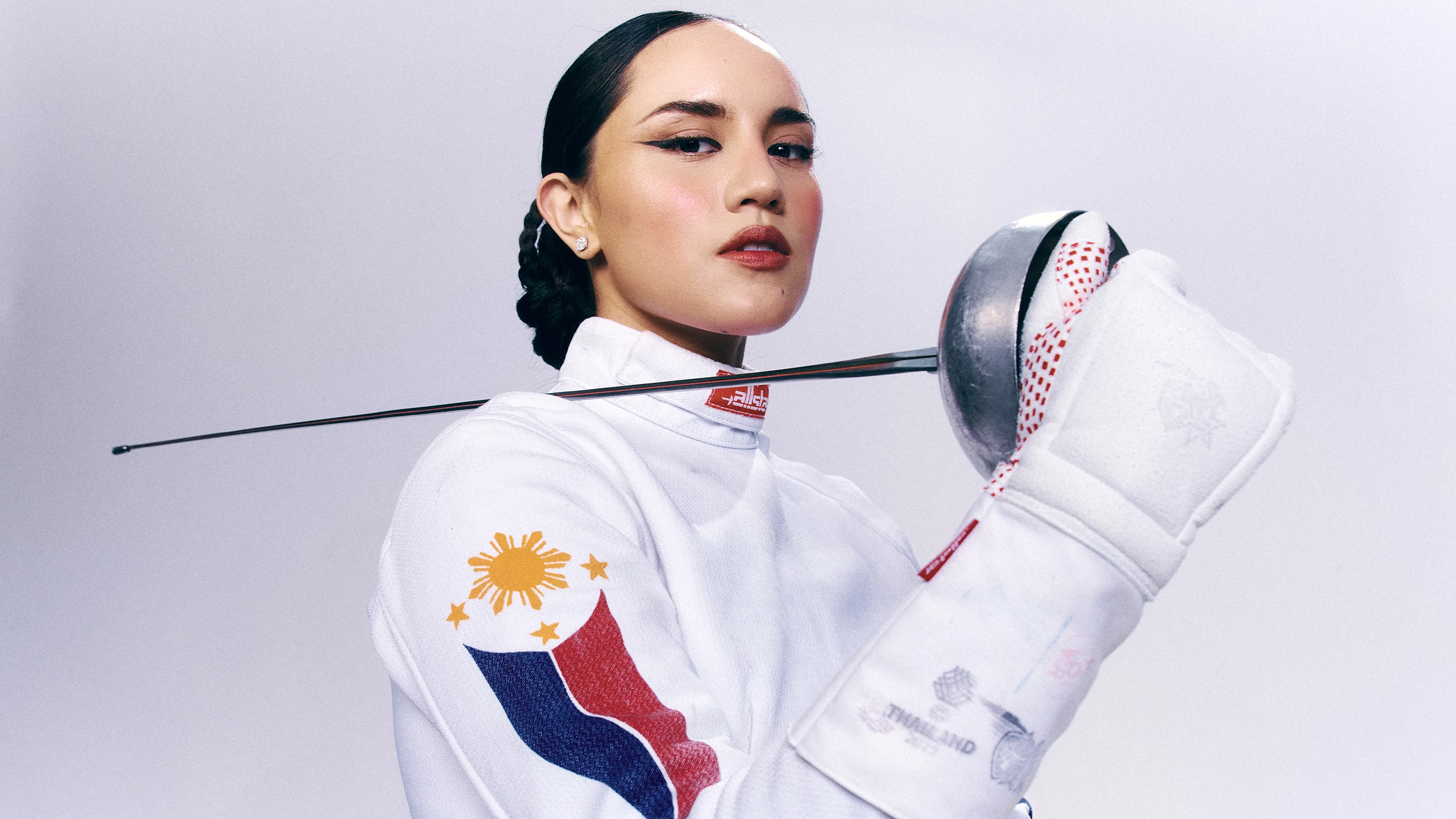
Ahead of the 2026 Asian Games, Juliana Gomez reflects with Allure Philippines on the losses and hard-earned lessons that brought her to the top of Philippine women’s épée fencing—and the work still ahead.
Before Juliana Gomez ever learned to hold a fencing sword, she learned to follow her curiosity.
Growing up, she was encouraged to try the things her parents loved, whether that meant arts and crafts with her mother, Lucy Torres-Gomez, or tagging along with her father Richard Gomez’s various sports training sessions between taping days. “My parents always exposed me to the things that they were interested in,” Gomez says.
Sports, it turned out, was what piqued her interest the most, partly because “I was horrible at painting and drawing and making collages,” she shares candidly. One of the sports her father introduced her to was fencing. She started when she was 11, but the sport did not immediately become her path. She moved on to volleyball, playing for the University of the Philippines’ women’s volleyball varsity team, before the pandemic brought her back to fencing.
“No one talks about how strange it is to start something new and take it seriously at a later age,” she says, reflecting on what it was like to return to fencing. “As an adult, some of the champions that we know today started playing when they were eight. And to start this at 20, it was one of the most humbling experiences of my life, because I had to go through the fire to make it to where I am today in the fencing team.”
The valuable lessons on losing

Kim Santos
“I hate losing, but I have lost more times than I can count,” Gomez shares openly with Allure Philippines.
She adds that she worked with a sports psychologist in 2020, while she was still trying to qualify for the national team. “It was such an uphill battle mentally. From working with him [I learned] how to accept loss, how to come back stronger, how to get back up, how to keep at it.”
That work changed how she understood defeat. “I actually think that winning doesn’t teach you much,” she says. “Winning, to me, it’s just an accumulation of all the hours that you put in. Losing, apart from showing you the things that went wrong in the game, it teaches you so much about yourself. It really molds your character.”
“Losing, apart from showing you the things that went wrong in the game, it teaches you so much about yourself.”
Through years of being an athlete and working with a sports psychologist, she learned that losing shouldn’t have to mean defeat forever; it could simply be a season of life.“I feel like losing is a blessing in disguise sometimes because when you’re just not ready to win, when you’re just not ready to be in the team yet, when it’s just not your time, you lose. And that’s okay, because the time that you spend trying to bounce back from that loss prepares you for something bigger,” she says. “It prepares you to shine when it’s actually your time. And when it’s your time, you’ll know.”
Learning that she belongs

Kim Santos
In 2025, after five years of hard work, her time finally came. She made the national team, and with it came a whole new scale of what was at stake. “It was scary because you work so hard for this one thing and then you get it,” Gomez shares of making it to the national team. “And then the weight of it kind of hits you all at once. And you realize, ‘Oh my gosh, I’m representing something so much bigger than myself.’ This time around, it’s not just my school, it’s my country. And it’s my responsibility to show the world whenever I compete abroad that this is what Philippine fencing can do.”
This sharpened her idea of what she wants people to see when she steps onto the international arena. “I have to show the world that on the strip, we’re also a threat and that we’re good enough, and that our local talent can compete with all of the international exposure that other countries have gotten in past years,” she adds.
When asked about how she feels about being number one, Gomez credits it to hard work. “Being number one just happened naturally,” she says. “I think it was a result of me stacking the days.”
But Gomez admits that the achievement came with a new kind of pressure: believing she deserved the place she had earned. “It’s so complex, because as an athlete, you work towards what you want. Sometimes you get it. In my case, I got it. And no one prepared me for the challenge of believing that I was good enough to be in that position or that I’m truly able, and that I’m the strongest possible fencer that the Philippine team can send to this competition.”
Beyond the strip
The process of discovering herself has shaped how she sees her body, her life outside fencing, and the parts of herself that exist beyond performance as a national athlete. “We live in an age where we see perfect bodies all the time,” Gomez says. “So much so that we think it’s normal. And so sometimes I think, why don’t I look like that? I’m training three times a day. I look super masculine in short dresses because my legs are just so big from squatting all day because of fencing.”
The strength her sport requires does not make her immune to the pressure to look a certain way. “I think to myself, my stomach could definitely be flatter, but I just love to eat after training because I’m just so tired and I love a good meal,” she says. “But then [I] realize, my body is so much more than that.”
That realization has made her question where the desire to change herself comes from. “I have to think sometimes, am I doing it for myself?” she adds. “Would it make me truly happier if I was more of this and less of that? Or is it more for people to judge me less or perceive me less for what they see physically? So I think that it’s something that I am actually starting to think a lot about more these days.”

Kim Santos
Away from competition, Gomez finds joy in the parts of life that have nothing to do with rankings. “I live for those moments in between training when I just need to do something with my hands and I don’t want to think,” she says. “I like to bake. Or sometimes when I’m so overwhelmed and overstimulated with the things that I have to do in a day, I like to take really long walks. Those are the things that are fun for me. To eat good food, to be with my friends and family, and to enjoy the little things. And I feel like I’ve found so much peace through that.”
That sense of contentment has become an important part of how she navigates the demands of fencing. “I just want to have fun with my life,” she says. “I want to enjoy everything that I do. And finding my balance and finding a routine throughout this fencing journey of mine has been so much fun.”
What comes after number one?
At present, Gomez believes her strongest years may still be ahead. “I’m 26 now,” she says. “The typical fencer who competes at an Olympic level for women, it’s when they’re 30, that’s when they peak. So I’m very excited for the time where I can say that I’m at my peak. Like I’m at my strongest, I’m at my sharpest.”
The Olympics remain an ambition, but so does the work required to keep improving. “And I just have to keep getting exposure from better fencers. I’m not afraid of hard work, but it will be a challenge mentally. That’s for sure.”
“I’m not afraid of hard work, but it will be a challenge mentally. That’s for sure.”
Still, her definition of being the best has moved beyond medals and records. “Let’s say you’ve won all of these gold medals, you’re number one. [But] I don’t necessarily think that it makes you the best.”
For Gomez, it is also about the kind of person she becomes along the way. “What makes you the best is when you’re a good role model to the people you fence with,” she says. “I think that that’s very important. It was because of the good role models in my life that I was able to benchmark myself.”
Taking the next chapter confidently

Kim Santos
Her famous parents are among these role models. For her, becoming her own person didn’t have to mean distancing herself from them or the name she grew up with. “My motivation is really to make the most out of what I have, to be the best daughter that I can, to honor God through everything that I do, to be the best possible role model to whoever it is that I fence with, to be just a good person. That is truly my motivation.”
Before every competition, Gomez grounds herself, sometimes carrying a rosary and sometimes sitting quietly in prayer. “My prayer is that if my best isn’t enough, please, please, please just fill in the gaps,” she says. It is a reminder that even as she pushes herself toward the next level, she does not have to carry the weight of becoming her best entirely on her own.
For now, Juliana Gomez is learning to stand fully and confidently inside what she has already earned. Yes, she is No. 1, but the ranking is not where her story ends. If anything, it is only the beginning of discovering what comes next, from the Asian Games to the Olympic dream, and becoming the person, athlete, and woman she wants to be beyond it.
Art direction and beauty direction by Nicole Almero. Photography by Kim Santos. Makeup by Booya Mocorro. Hair by Patty Inojales. Styling by Alvin Navarro and Paul Cenizal of Studio 24c.
Frequently Asked Questions
Juliana Gomez is the Philippines’ No. 1-ranked senior women’s épée fencer and daughter of actors Richard Gomez and Lucy Torres-Gomez. She made the national fencing team in 2025 after five years of training, following an earlier career playing varsity volleyball at the University of the Philippines.
Gomez first tried fencing at age 11 through her father, actor Richard Gomez, but moved on to varsity volleyball at the University of the Philippines. She returned to fencing seriously at 20, during the pandemic, and has trained consistently ever since to reach the national team.
Gomez worked with a sports psychologist starting in 2020 to manage repeated losses while trying to qualify for the national team. Five years of consistent training and mental conditioning led to her 2025 national team selection and her current No. 1 ranking in women’s épée fencing.
Gomez says losing taught her far more than winning ever could, calling it a blessing in disguise that prepares athletes for their moment to shine. She credits working with a sports psychologist since 2020 for learning to accept defeat, rebuild, and come back stronger each time.
Yes. Gomez is representing the Philippines in women’s épée fencing at the 2026 Asian Games while continuing to work toward an eventual Olympic bid. She notes that fencers typically reach peak competitive form around age 30, a milestone she is still building toward.