In Their Own Words: These Filipino Celebrities Reflect on the Beauty of Coming Out of the Closet
How do you come to terms with who you are under the weight of public scrutiny? For Mond Gutierrez, Angie Mead King, Rajo Laurel, Jon Santos, and Tim Yap, it began with owning their narrative.
By Liam Sanchez


The closet is the most befitting metaphor for queer people who are not yet ready to publicly identify with their sexual orientation, gender identity, and expression. A closet is a space where things deemed unfit for display are kept. And when you shut the door, it becomes dark and confining, with no room to move and let light in.
Coming out of the closet, then, is so significant, deeply personal, and intimate that it is often difficult to open up even to family or friends. But what happens when that experience unfolds beyond the spaces of a home and you’re forced to confront your identity under the gaze of a public that might not always be forgiving?
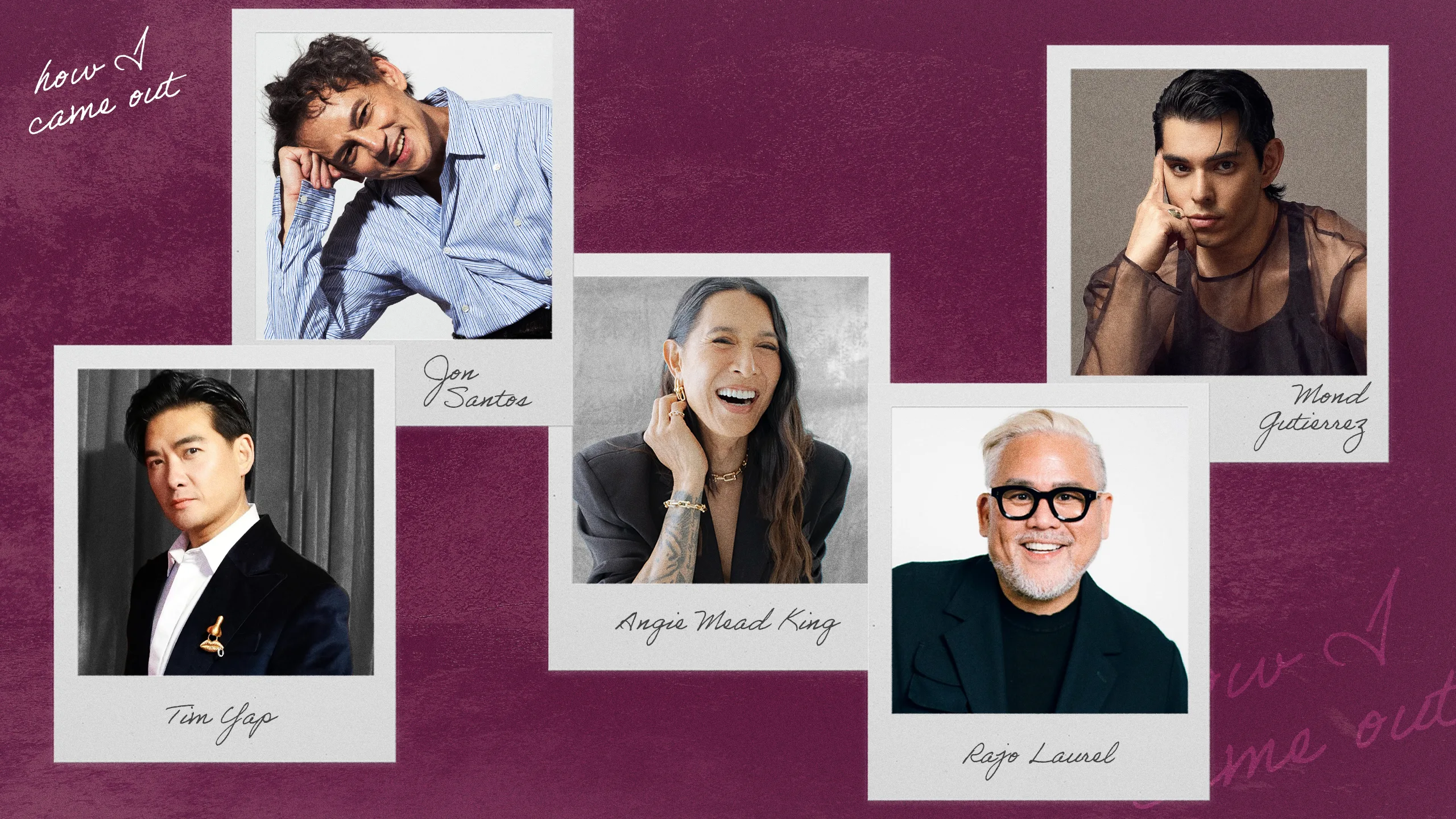
Powerhouse Filipino LGBT+ trailblazers across industries—multi-hyphenate Mond Gutierrez, entrepreneur Angie Mead King, fashion designer Rajo Laurel, actor Jon Santos, and eventologist Tim Yap—also went through the same process of coming to terms with who they are, just like everyone else in the community.
In this special Pride Month feature, they share with Allure Philippines their coming out stories, how they braced themselves for public opinion, and how truth has allowed them to be seen and exist without having to ask permission.
Read on as they share about their journeys of becoming and belonging.
Mond Gutierrez
Multi-hyphenate creative Mond Gutierrez has always been in the spotlight. His surname instantly rings a bell to many, being part of one of the most prominent families in Philippine entertainment. His mother, Anabelle Rama; father, Eddie Gutierrez; and siblings, Ruffa and Richard are all established figures in the industry. Yet within the family, fame takes a backseat. Beyond the weight of the surname is a space where it no longer defines him—where Mond was finally able to begin trusting himself.
When you chose to come out publicly, what went into that decision, and how did you prepare yourself for the response at the time?
For me, coming out publicly wasn’t a spontaneous decision. It came after years of learning to be comfortable with myself first. I was fortunate in that I always felt the love and support of my family and friends. They never made me feel different or less than, and because of that, I never felt pressure from the people closest to me. In many ways, the journey was more about finding the confidence to share that part of myself with the wider world.
Growing up in the public eye and coming from a well-known family, I understood that sharing something so personal would inevitably become a conversation beyond my own circle. I spent a lot of time reflecting on whether I was ready for that, and ultimately realized that the greater burden was continuing to hide parts of myself.
What gave me the confidence to do it was the understanding that authenticity is freeing. I prepared myself for a range of reactions – supportive, critical, and everything in between, but I also knew that if I was honest about who I was, the response would no longer define me. The decision was less about making a statement and more about choosing peace.
Looking back now, how has that moment shaped your career, your relationship with your audience, and the responsibility you feel as a visible LGBTQIA+ figure today?
Looking back, coming out became one of the most important moments of my life. It strengthened my relationship with my audience because it allowed them to see me more fully, not as a curated version of myself, but as a real person. I think people connect most with honesty, and being open about who I am creates a deeper sense of trust and authenticity.
Professionally, it gave me the freedom to move through my career without feeling like I had to edit parts of myself. Whether as a host, producer, creative director, or content creator, I’ve been able to focus my energy on the work rather than on hiding who I am. It also opened opportunities to have more meaningful conversations around representation, visibility, and acceptance.
Today, I’m very aware of the responsibility that comes with being a visible member of the LGBTQIA+ community. I don’t see myself as someone who has all the answers, but I do understand the importance of representation. Growing up, there were fewer examples of LGBTQIA+ people being celebrated for who they were, so if sharing my story helps someone feel seen, understood, or less alone, then that means a great deal to me.
Angie Mead King
Entrepreneur and race car driver Angie Mead King drew strength from the unwavering support and acceptance of her mother and her partner, Joey Mead King, allowing herself to be seen for who she truly is: a woman. Today, as King balances configuring some of the coolest sports cars alongside building her farm, she has learned to fully embrace herself, proof that being unapologetically yourself can be the greatest freedom of all.
When you chose to come out publicly, what went into that decision, and how did you prepare yourself for the response at the time?
Before coming out publicly, I was actually out already to my friends and family. When my father passed away, I was devastated and torn. I was holding back from coming out because I didn’t want to tarnish his reputation. But one day when I was having lunch with my mom, she basically said, “What are you waiting for? I can see you already.” So that day I went home and asked Joey if she was ready because it was going to become crazy gossip for Manila for sure. I told my friends as well and everyone was on the defensive, thinking of the backlash that I was going to face. I was prepared to close my businesses and move [to another] country in case it got really bad. But in some perfect story, everything panned out pleasantly and no such negativity came forth from my coming out. Instead, outpouring of support of love and praise for Joey and I emerged, which was contradictory to what we were expecting.
When I came out, I did it for myself not for anyone else. I was at the point in my life where other people’s opinions did not matter and what mattered was my own thoughts aligned with how I think and see myself. In short it was literally IDGAF.
Looking back now, how has that moment shaped your career, your relationship with your audience, and the responsibility you feel as a visible LGBTQIA+ figure today?
Looking back now if it had gone the opposite of what had happened, I would have probably moved to a different place or chosen a different career but I am truly blessed to have a supportive audience in both my personal and professional life. I live life as an open and proud transgender woman who is in the space of a male-dominated industry. In the beginning I definitely thought I would detach from my love for motorsports and anything automotive, but I have managed to carve out my own niche in the industry that I am enjoying.
I don’t think I want to confine myself to the responsibility of just being a visible LGBTQIA+, but being a visible good human being who is compassionate, kind, and a contribution to society.
Rajo Laurel
In fashion, a dress is often seen as armor. But renowned fashion designer Rajo Laurel feels most like himself when he lets go of pretension. And growing up in a family where he doesn’t need to explain who he was, allowed him to truly be in touch with his queerness. Perhaps it is that authenticity and openness that lets his creativity thrive, forming a long-spanning career that can only be done by staying original. Today, Laurel wants to carry that experience to the younger queer generation as a role model that being who you are can bring out the best in you.
Can you share your coming out story? What was the process like for you, and what were some of the biggest fears, expectations, or realities you encountered along the way?
My coming out story was actually quite uneventful, primarily because I really didn’t have to come out. I am blessed and very fortunate that I have family members who were already out and open. The queer space in our family was quite liberal in the sense that I had aunts who were lesbian and I had gay uncles and essentially they helped me transition and helped me open up this beautiful, colourful world of queerdom.
Although there were still some fears and although there was some anxiety along the way of coming out, like any young queer person, you actually develop this and overcome this as time happens. However, the process of coming out was quite beautiful, primarily because at a very early age, they already saw that I was queer and essentially it was almost like, ‘Oh, Rajo belongs to our tribe.’ And because of this, I had an easier time being accepted and also accepting myself in terms of how I was as a gay person.
Looking back now, how has coming out shaped your sense of self, your relationships, or the way you move through the world today?
Looking back now, I was very blessed. I really want to be an example, like my relatives who were ahead of me. Essentially I want to be that person for young queer people to identify with, primarily because we need people to identify with, specifically towards our life choices and the way we would live and lead our lives. I think it’s very important that as a queer person, you have examples of men and women who would show you that we can actually lead very respectful lives and successful lives at that. I’d like to be an example of that.
Jon Santos
A certified chameleon on stage, effervescent comedian Jon Santos has mastered the art of putting on a show. A thespian through and through, moving across television and theater, he has taken on countless personas—impersonating celebrities and even portraying politicians in displays of wit, talent, and tenacity. As he slips into wigs and puts on makeup to deliver his spoofs, he continues to redefine the range of his craft. But among the many characters he has played, and continues to play, he returns to the most important role of all: being himself.
When you chose to come out publicly, what went into that decision, and how did you prepare yourself for the response at the time?
I entered the theater and comedy club world already as an ‘out’ performer. I was encouraged by the ‘very free’ comedy climate brought about by Edsa 1, and was encouraged by my mentors (Tessie Tomas and Willie Nepomuceno) to try sharing my own brand of satire, crafting my own set of political celebrity impersonations, often with the use of drag. I always assumed that regarding my private life, everybody already knew, or didn’t care, or simply cared more about the work. I was rarely featured in any interview ‘as myself.’ Even in interviews, I was requested to do the pieces in character, with matching pictorial. The ‘Jon as himself’ took the backseat.
Looking back now, how has that moment shaped your career, your relationship with your audience, and the responsibility you feel as a visible LGBTQIA+ figure today?
Looking back, I feel I was able to come across (to my audience) as open, authentic, and accessible. Once in a while, a newbie drag artist would tell me, ‘Nagka lakas-loob ako to share my own drag after I experienced watching you and studying your work.’ That always brings a smile to my face.
Tim Yap
English needs a better word to define Tim Yap’s body of work, so much so that he coined the term “eventologist.” He is the pioneering force behind Manila’s biggest parties and social gatherings; hence, every Tim Yap invitation is a red-letter occasion. But beyond the glamour of his productions, he has fully embraced his identity and fallen in love in quieter, more intimate ways. His personal journey has not only shaped his own self-acceptance but also compels him to make space for others to do the same. In doing so, he shows that it is sincerity, not grand gestures, that makes love real.
Can you share your coming out story—what the process was like, the realities you encountered along the way, and how, looking back, it has shaped your sense of self, your relationships, and the way you move through the world today?
I never really thought much about “coming out” growing up because it simply wasn’t something we talked about at home. Around our dinner table, the conversations were always about our dreams, our ambitions, and the lives we wanted to build—not about who we wanted to love. It just wasn’t a topic in our family, so I never saw my sexuality as something that needed a formal announcement.
Ironically, my coming out happened in one of the most public ways possible.During my birthday celebration, I proposed to my then-partner, Javi. Before the news spread, I called my mom while I was on my way to Tokyo. I told her, “Mom, before you hear it from everyone else, I want you to know that I proposed.”
She asked, “Proposed to who?”
“To Javi,” I said.
There was a pause. Then she replied, “That’s a guy.”
I think that was the moment everything became real for her. Soon after, the proposal was on CNN and picked up by media everywhere. What could have been a quiet family conversation suddenly became a very public coming-out story.
Later, while I was still abroad, I learned from my siblings that my mom had been crying. She blamed herself and struggled with the fact that something so personal had unfolded on such a public stage. When we finally spoke, I told her that I was planning to build a life with the person I loved. Through her tears, she simply said, “Whatever makes you happy.”
Those words meant everything to me. I know it wasn’t easy for her. She had to process it in her own time, and I had to give her the space to do that. Looking back, I realize that more than protecting myself, I was trying to protect her feelings.
For me, my journey has never really been defined by the act of coming out. I’ve always tried to live a life that is joyful, authentic, and open. I never felt that being different was something that diminished anyone else. If anything, I believed my uniqueness gave me something meaningful to contribute.
That’s also what Pride means to me today. It’s not simply about declaring who you are—it’s about celebrating your uniqueness, living your truth with joy, and using your life to make space for others to do the same. When you embrace yourself fully, you give other people permission to embrace themselves too.
My coming-out story wasn’t one dramatic moment. It was a journey of love, understanding, and grace. And I’m grateful that, in the end, love proved bigger than fear.
The beauty of owning your truth
Coming out of the closet is a gamble on what awaits beyond its doors. But there is a lesson to be learned: that there is beauty in allowing ourselves to be loved, because sometimes all it takes is knowing there are people beside us to give us the courage to step forward.
It is by creating a space where one can exist freely and live their truth that becoming is not a statement, but simply a way of being.
Frequently Asked Questions
Mond Gutierrez described coming out as a gradual process rooted in existing family support rather than a single announcement. Growing up in a prominent Philippine entertainment family, he weighed public scrutiny carefully before sharing his identity, ultimately choosing authenticity over continued concealment.
Angie Mead King’s mother encouraged her to stop holding back, telling her she could already see the truth. This support, alongside her partner Joey Mead King, gave her the confidence to come out publicly despite anticipating backlash that ultimately never materialized.
Rajo Laurel says he never had to formally come out, since his family already included openly queer relatives — gay uncles and lesbian aunts — who helped him embrace his identity from an early age within an accepting environment.
Jon Santos entered the comedy and theater scene already living openly, encouraged by the freer cultural climate after EDSA 1 and mentors like Tessie Tomas and Willie Nepomuceno. He built a career using satire and drag rather than concealment.
Tim Yap’s mother initially struggled emotionally after his proposal to his then-partner Javi became public via CNN, but ultimately responded with acceptance, telling him, “Whatever makes you happy,” after processing the news privately.
Liam Sanchez
Liam Sanchez is a registered medical technologist and Wellness Writer at Allure Philippines. Combining training in laboratory medicine with experience in science journalism, he specializes in evidence-based reporting on wellness, nutrition, longevity, and beauty trends. A Cum Laude graduate of the University of Santo Tomas, he previously served as Science and Technology Editor of The Varsitarian. At Allure Philippines, he translates complex health and beauty science into accessible, reader-first stories that help consumers make more informed decisions about their well-being.
Latest Stories


You might also like

To provide a customized ad experience, we need to know if you are of legal age in your region.
By making a selection, you agree to our Terms & Conditions.